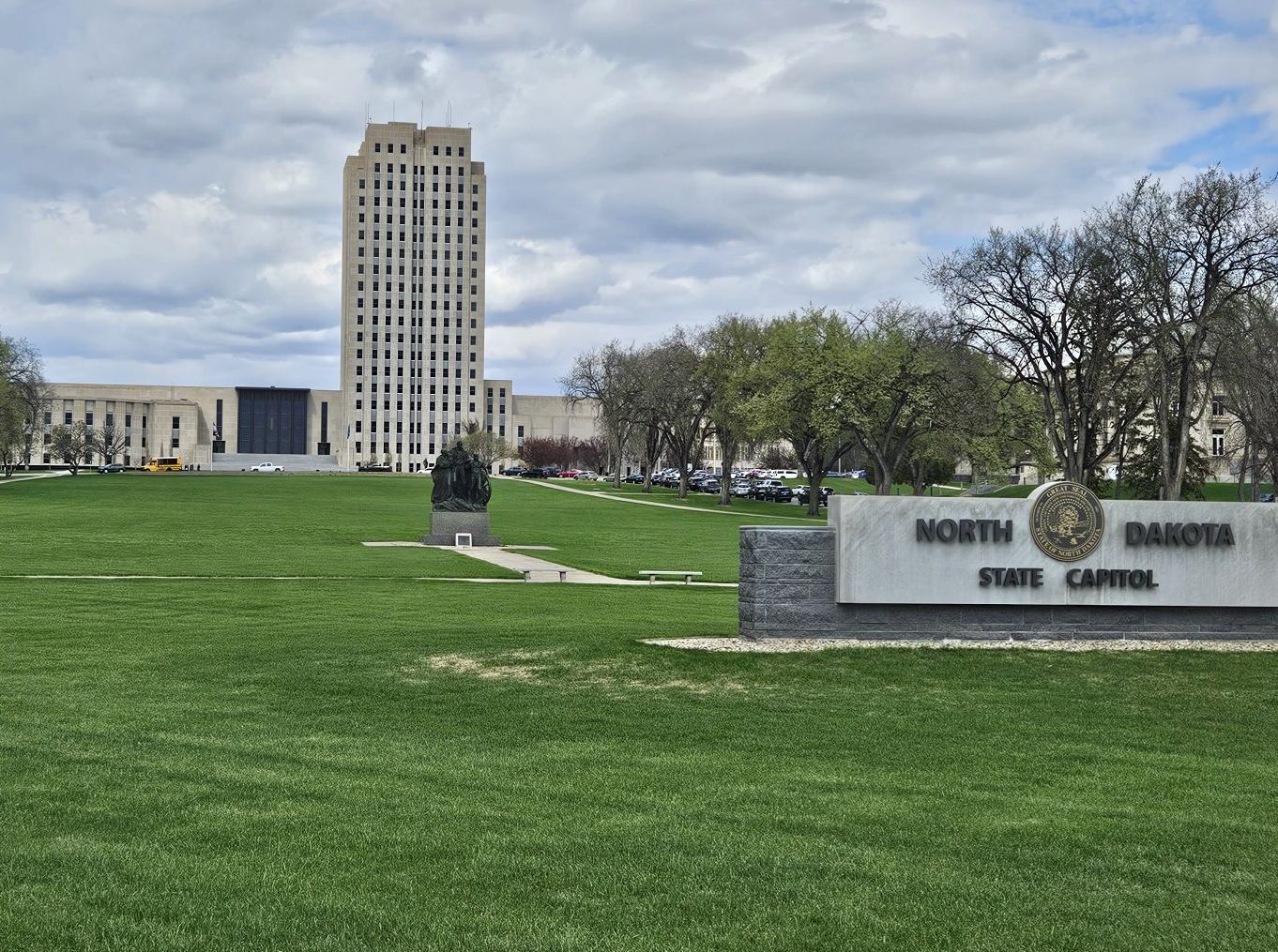
Lawmakers Consider Major Changes to Road Funding & Property Tax Bills

Two actions took place this week that could prolong the work of the Legislature. With 15 days to go before lawmakers hit the maximum number of days allowed, there’s a lot of work yet to do and yet we are seeing a lot of maneuvers making significant changes to bills as committees finish their work on bills. Many of these concepts have come at a surprise, with no prior conversation in committee or during testimony.

PROPERTY TAXES

First, the Senate Finance and Tax Committee took up one of the property tax relief/reform bills still waiting to be acted on. HB 1168 as introduced would have provided relief through the school funding formula by the state buying down additional school mills, it also capped local governments from increasing their levies by 3%. The Senate committee amended the bill moving to providing the relief utilizing the primary residence credit and increasing that amount to $1,650. HB 1168 now looks very similar to HB 1176. In addition, the committee made improvements to HB 1168 by addressing some technical concerns NDACo had with HB 1176. One of those amendments to HB 1168 now allows the primary residence credit to be applied to all taxes owed including voter approved levies as well as includes a provision that the credit can cover a max of 75% of the property taxes owed up to $1650 and minimum of $500. The Senate approved the amendment to HB 1168; Senate Appropriations will hear the bill early next week. It is uncertain at this time what the strategy is to have two nearly identical property tax bills still in the mix.

Meanwhile, the conference committees have been appointed for HB 1176. Representatives Headland, Bosch & Nathe along with Senators Weber, Bekkedahl & Erberle. These lawmakers will meet next week to go over the differences between the House and Senate versions of HB 1176 and try to come to a compromise.

ROAD FUNDING

A number of amendments were brought forward in SB 2012, the NDDOT Budget, that would restructure local road funding sources. These changes were discussed in the House Appropriations Government Operations sub-committee and will be forwarded to the full House Appropriations committee for their consideration. These amendments are a substantial change from the version of the bill as it was approved by the Senate. Some of the greatest changes proposed through the amendment would eliminate prairie dog buckets in the oil & gas revenue buckets and instead allocate funds for local roads in the SIIF bucket. The amendment also proposes a 5 cent gas tax increase. While this proposal could provide additional funds and greater certainty for local funding; the downside could be the loss of local control in determining how these dollars should be used as a great percentage of the local dollars would be allocated through a grant process. Again, lawmakers will have further opportunities to make changes to this amendment. Here is a summary of the amendment:

  • Transfer $370M from SIIF to Flex Transportation Fund
    • Adding the use of these funds for “other infrastructure” in addition to road and bridge projects, so water/sewer projects for cities can be included for use of these funds
    • $159.1M is allocated for grants to counties, cities and townships in non-oil producing counties for road and bridge projects
    • $49.9M is allocated for grants to eligible counties for bridges/bridge maintenance
    • $42.5M is allocated for county formula distribution (same for cities)
    • $25.9M is allocated for township formula distribution
    • Non-oil producing county is defined as county that had average annual oil production of fewer than 10 million barrels (based on avg over a 3 year period)
  • Removing Prairie Dog Bucket and including funding in the SIIF Bucket
  • Under the Highway Tax Distribution Fund (direct distribution):
    • $205.9 distributed to counties/cities
    • $20M distributed to townships
  • 100% of Motor Vehicle Excise Tax would be returned to the State’s General Fund
  • Proposing a $0.05 fuel tax increase which would generate an additional $70M
  • Proposing to bond the Hwy 85 Project of $155M

There is also a proposed amendment for additional criteria in the Flex Fund selection process to consider projects in counties, cities and townships that have a zoning ordinance or policy that are more restrictive than the state in the areas of agriculture or energy.

The Senate Finance & Tax Committee amended HB 1382 which seeks to increase the gas tax 3 cents to strike out the language that limited the funding to non-oil counties, so the share of the gas tax increase would go to all counties, cities and townships.

OTHER NOTABLE BILLS

  • HB 1193: Back the Blue grants – $3.5 m to local law enforcement for retention bonuses. PASSED Senate – expect House to Concur.
  • HB 1197: Study of jail infrastructure needs – FINAL Passage.
  • HB 1361: Maximum penalties for Human Trafficking offenses – FINAL passage
  • HB 1482: Requires bond elections to be on primary or general election, still includes a 60% threshold vote approval. PASSED Senate – expect to go to Conference Committee.
  • HB 1298: Increases speed limit on interstate to 80 mph & changes speeding fees and point system. PASSED Senate.
  • HB 1053: Repeals limitation that restricted DOT from adding road miles on state highway system – FINAL Passage
  • The Senate concurred with House amendments to SB2267 putting septic system authority under DEQ while retaining inspections and permitting at the local level.
  • HB1577 was introduced to address the more than 300 ND communities identified as having wastewater and stormwater needs by DEQ. This bill establishes a wastewater infrastructure grant program and consideration of a legislative management study to explore funding sources. Responding to a sudden loss of Federal funding grants already awarded, the Senate Appropriations Committee amended the bill authorizing BND to provide a line of credit. This is considered one-time funding and passed the Senate floor with an emergency clause attached.
  • HB 1588: Related to where possess weapons. Public buildings amended out of bill. FINAL Passage
  • HB 1591: $1.5 million grant for county fairs – FINAL Passage

DHHS BUDGET

The DHHS budget bill, HB1012, passed on the Senate floor as amended by the Senate Appropriations committee. The state’s largest budget includes funding from general funds, SIIF, CHTF (Community Health Trust Fund) and Federal funds. Some of the notable changes made from the House budget are:

  • $5M from SIIF for a behavioral health facility in Grand Forks revised from the $12.96M House allocation
  • $4.4M one-time funding from the community health trust fund for a licensed intermediate care facility in the south central human service region to provide services to children or young adults with medically and behaviorally complex conditions
  • $585,000 general funds for crisis service grants serving young adults at risk of homelessness or experiencing other serious adverse life events; this reflects the same amount in the last biennium and was added on the Senate side
  • Since construction for a new Community Cultural Center facility supporting Native American heritage will not ready this biennium, the Senate replaced $1M for the facility with $300,000 for a cultural program
  • $500,000 reduced from $750,000 in the House for one-time funding from the community health trust fund for juvenile justice diversion services and programs
  • $750,000 Statewide Health Strategies from CHTF removed

WHAT TO EXPECT FOR NEXT WEEK

Legislative leadership provided insight on the budget and remaining bills in closing comments this week:

  • Currently, proposed bills are overspending in General Fund by $300 million and the SIIF by $200-$300 million
  • Appropriations committees are looking for budget reductions
  • There are 170 bills left to decide with 50 bills in conference committee
  • Multiple floor sessions a day, starting at 8 a.m. Monday
  • Conference Committees will meet several times a day at any time floor sessions are not scheduled.

Click to view a list of scheduled bills that have committee work or conference committee meetings. This list automatically updates multiple times a day.

Click to view a list of the high priority NDACo bills still active.

Conference Committee Activity to Ramp Up this Week

Monday marks day 61 of the Legislative Session that is limited to 80 days. Legislative leadership has indicated their goal is to wrap up their work by the end of the month. Very few bills remain in policy committees and appropriations committees are completing their work on budget bills. The shift this week into conference committee mode will be very noticeable. This is where the differences are worked out in bills passed by the House and Senate. At this point in the process, the schedule is fluid, and not much advance notice is provided for when conference committees meet. The best way to stay on top of the schedule is to follow the NDACo bill tracking link which updates multiple times a day. Click here to view the NDACo Bill Tracking Schedule.

Property Tax Relief / Reform

We anticipate the major property tax relief/reform bill, HB 1176, will have movement this week. The Senate made significant changes to the bill including reducing the amount of relief from $1450 to $1250. The House is expected to not concur with the change and appoint a conference committee early this week. A conference committee will more than likely meet this week. NDACo has met with House and Senate members on suggested technical changes to the bill. One of the changes we would like to see includes removing the exclusion of the primary residence credit from voter approved levies. The Senate Finance and Tax Committee continues to sit on two other property tax relief/reform bills (HB 1168 & HB 1575).

Septic System Bill Progress

The Senate defeated HB1541 which included a hefty fiscal note from the Department of Environmental Quality (DEQ) for additional duties. DEQ estimated two full-time equivalent (FTE) positions would be needed to adopt rules regarding the licensing, permitting, and inspections of sewer, septic and private water system. The House Energy and Natural Resources Committee gave a Do Pass recommendation on SB 2267 after adopting amendments that largely mirrored language from HB 1541. Additionally, the fiscal note from HB 1541 was removed and instead included a one-time appropriation to defray costs incurred by DEQ for program implementation. Committees in both Chambers recognize the importance of passing a bill to address this multi-session issue.

Priority Bills to Watch this Week

Click to view list of NDACo Priority bills that are still active

  • HB 1176 – Property Tax Relief / Reform – Conference Committee
  • HB 1168 – Property Tax Relief / Reform – Senate Tax
  • HB 1575 – Property Tax Relief / Reform – Senate Tax
  • HB 1382 – Gas tax increase for roads – Senate Tax
  • SB 2015 – DOCR Budget – House Appropriations
  • SB 2012 – DOT Budget – House Appropriations
  • HB 1012 – DHHS Budget – Senate Appropriations
  • HB 1193 – Back the Blue grants – Vote in Senate possibly Tuesday
  • HB 1015 – OMB Budget includes additional Prairie Dog buckets
  • HB 1482 – Bond elections for cities, counties and schools to take place during Primary or General Election. DP in Senate Tax – vote on Senate floor.
  • HB 1534 – 3% cap on property values for taxation purposes. DNP recommendation in Senate Tax – goes to Senate for vote.

Public Safety Bills

  • HB 1003: Attorney General budget – The Senate approved including language prohibiting Judges from waiving 24/7 fees. This is identical language as what was in SB 2365 that was defeated. The bill is likely to head to conference committee.
  • HB 1225: Increases penalty for reckless endangerment crimes with a firearm – PASSED Senate
  • HB 1596: Decriminalized small amounts of marijuana – FAILED in Senate
  • HB 1419: Allows 911 dispatchers & EMS to enroll in public safety NDPERS plan if offered by political subdivision. FINAL PASSAGE
  • HB 1197: Study infrastructure needs of county and regional jail facilities. Bill was introduced as $50 million in jail improvement grants – FINAL PASSAGE
  • HB 1375: Related to fake ID’s and the penalty. FINAL PASSAGE
  • HB 1613: Use of Robots by law enforcement. Amended to address law enforcement concerns. PASSED Senate – returns to House for review.

Other Bills Worth Noting

  • HB 1259: Eliminate Daylight Savings time – FAILED
  • HB 1387: Schools required to be closed if polling place on Election Day – FAILED
  • HB 1297: Prohibits rank choice voting – PASSED Senate
  • HCR 3003 – Increases threshold for votes needed to change state constitution measures to 60% – PASSED Senate

Senate Reduces Property Tax Relief Plan

The big headline of the week is the Senate’s action on HB 1176, one of the major property tax relief bills. The Senate on Thursday approved an amended version of HB 1176 that reduced the amount of property tax relief for primary residences from $1,450 to $1,250. The Senate’s objective for lowering the relief is to pay for it using Legacy Fund earnings and no General Fund dollars. Amendments also included a provision that limits the credit to cover no more than 75% of the taxpayer’s liability but provides a baseline credit of $500. The bill expands those eligible for the homestead credit and increases the renter’s credit. On the reform side of the bill, restrictions in HB 1176 stayed the same. Local governments are capped at a 3% growth on the dollars they can levy. However, the bill allows local governments to carry over unused caps, exempts emergency levies and allows voters to approve exceeding the cap for up to four years. The Senate approved HB 1176 47-0.

Because of the difference in the Senate and House versions of HB 1176, it is highly anticipated the House will Not Concur with the Senate’s changes. If that happens, a conference committee of three members from both the House and Senate will meet to work on a compromise version. NDACo has identified some technical corrections that need to be made to the bill that will prioritize to be addressed in conference committee. We expect the conference committee to be appointed and more than likely meet this week.

In the meantime, the Senate Finance & Tax committee is still sitting on three of the property tax relief/reform bills (HB 1168, HB 1575 & HB 1534). The committee is scheduled for committee work Monday-Wednesday.

The House on Thursday spent nearly two hours debating SB 2128 the Attorney General’s Truth in Sentencing bill, which was drastically amended and then defeated with a vote of 41-52. The bill required violent offenders, drug traffickers and sex offenders to serve at least 50% of their sentence.

Other bills that saw action this week:

  • HB 1572 – Included study language on tax statements – Senate Defeated
  • HB 1588 – Related to where can carry firearms, as introduced the bill would have allowed firearms in public buildings but was amended to restrict the possession as it is currently in code. Senate Passed.
  • HB 1340 – Increases the amount of window tint allowed in front vehicle driver & passenger windows. Supporters showed up in sunglasses for the bill signing. Signed by Governor Armstrong.

The schedule for bills scheduled for hearings and conference committees can be viewed/downloaded here. Reminder that the schedule updates so it will change as conference committees or appropriations hearings are scheduled.

Weekly Update for March 24-28th

There is great anticipation this week in watching what happens next with HB 1176. That’s the property tax relief bill sponsored by Rep. Nathe and touted by Governor Armstrong to increase the primary residence credit which also caps local government. The Senate Appropriations committee amended the bill Thursday afternoon. They adopted amendments to reduce the primary residence credit to $1250 and limiting the credit to cover no more than 75% of a taxpayer’s liability. This amendment was pitched to ensure taxpayers are paying for some of the local services they receive. The other amendment approved provides intent for relief to be expanded to other taxpaying classes next session. Four other amendments were discussed but failed including a 2% cap for larger cities and counties and eliminating the ability to vote to exceed the cap until 2028.
What’s next: The amendments will be voted on in the Senate possibly Tuesday and then if the amendments are approved, the bill in its entirety will be voted on the next day. Because the bill has changed since coming over from the House. It is highly likely HB 1176 will go to conference committee where three members of each the House and Senate will work out differences.

Several other tax bills are still sitting in the Senate Finance & Tax Committee. We anticipate they will work on these bills this week and are also waiting to see how HB 1176 progresses. Of those bills, HB 1168 buys down school mills to provide relief and also caps local government and HB 1575 reduces the tax rate for property classes and caps taxable valuation.

Transportation Related

HB 1382, which seeks to increase the gas tax 3 cents for counties, cities & townships was heard. Rep. Hagert proposed an amendment to expand the funding to all, not just non-oil producing. The bill will provide $42M per biennium in funding broke out as follows: $18M for counties, $10M cities and $14M for townships. 

House Appropriations continues to work on the NDDOT budget SB 2012 which also includes local road funding by using 100% of the motor vehicle excise tax, legacy earnings fund and Flex Transportation Fund.

Law Enforcement Related

  • SB 2128 which is the Attorney General’s Truth in Sentencing bill had a long hearing Monday. The committee heard from the Attorney General, State’s Attorneys and law enforcement in support of the bill. The committee did not discuss or take action on the bill.
  • HB 1193 provides $3.5 million to local law enforcement & corrections officers for recruitment and retention bonuses was given a Do Pass recommendation from the Senate Workforce & Development Committee. The bill has been referred to Appropriations.
  • Two bills introduced to provide assistance to counties for jail improvements have been stripped. HB 1213 was defeated in the Senate (20-27) after being amended in Appropriations to include $20 million in additional infrastructure revolving loan funds. HB 1197 was amended in the House into a study of jail needs, attempts to return the bill back to its original purpose as a grant for jails were unsuccessful.

Public Health Related

Although septic system bills are still being considered in committee, SB2308 placing the onsite wastewater recycling technical review committee under DEQ passed the House. HB1541 was amended in Senate Ag & Veterans Affairs to eliminate advisory committee language based on the efforts to limit state boards and committees. The committee is holding this bill pending status of related SB2267 being reviewed in House Energy and Natural Resources. Legislators agree that a bill addressing this multi-session issue is needed and are working together for resolution.

  • HB1114 capping out-of-pocket insulin at $25 passed both chambers
  • The Senate passed an amendment to HB1454 exempting local public health units and human services zones from an opt-out procedure for required vaccines. The bill is on the Senate floor calendar for passage as amended.
  • HB1391 failed 17-29 on the Senate floor after rejecting a floor amendment. This bill would have created a new protected class status. GNDC and North Dakota Student Association were among those in opposition with health care systems and providers.
  • A legislative management study regarding limiting the release of self-spreading viruses and bacteria, HB1458, was also defeated in the Senate.
  • A motion to reconsider failed SB2105 relating to school surveys was defeated.
  • The House did not concur with Senate changes to HB1440 and now moves to conference committee.

Many committees have wrapped up hearing bills assigned to their committee and will shift to working on those bills and taking action to get them out of committee. Click here to see the schedule of bills being heard the week of March 31st.

Senate Appropriations Votes to Reduce Property Tax Relief in HB 1176

The Senate Appropriations Committee held committee work on HB 1176 Thursday afternoon. HB 1176 is the property tax relief bill that includes a $1450 primary residence credit and caps local government from increasing the dollars they levy by 3%, it does allow political subs to exceed the cap with a majority vote.

Senate Majority Leader David Hogue and Senator Mark Weber brought five amendments forward for the committee to consider. Senator Tim Mathern also proposed an amendment. Two of the six were approved and are now included in HB 1176.

  1. Primary Residence Credit is limited to no more than 75% of a taxpayer’s tax bill. Maximum relief is reduced to $1,250 and the credit may not be less than $500 as long as $500 or more is owed. Motion to Approve – PASSED
  2. Legislative intent the 2027 Legislative Assembly should provide relief to additional property taxpayers. Motion to Approve – PASSED
  3. Strengthens cap to 2% in 2025 for counties and park districts with populations over 20,000 (8 counties) and cities over 10,000 for year. Motion to Approve – FAILED
  4. Eliminated ability for political subdivisions to vote to exceed the cap until 2028 primary or general election. Motion to Approve – FAILED
  5. Allows townships to levy up to 36 mills without a cap. Motion to Approve – FAILED
  6. Senator Mathern proposed an amendment to eliminate the caps in HB 1176. Motion to Approve – FAILED

Next Steps: HB 1176 now includes the amendments (1 & 2 listed above). The Senate is expected to vote on the amendments Monday and if those amendments are approved the bill in its entirety could be voted on Tuesday. Because the Senate changed the House bill, the House can decide to not accept the Senate’s changes and move the bill to a conference committee to work out the differences. In other words, this bill is far from being done.

The Senate also has several other property tax relief bills that include restrictions for local government that remain in the Senate Finance & Tax committee. It is unknown when they will be acting on those bills.

Weekly Report for March 17-21

Property Tax Relief bills continue to be worked on… The week started off with a hearing on HB 1176 the property tax relief bill that provides $1450 in relief through the primary residence credit and restricts local government spending by limiting levies to a 3% growth rate. Several testified expressing concerns with the 3% cap but after two and a half hours of testimony, the committee acted right away on the bill without discussion on the items brought forward. The Senate Finance & Tax committee gave the bill a Do Pass recommendation and referred the bill to Appropriations. The Appropriations hearing is scheduled for Monday, March 24th at 2:00. NDACo has heard there may be amendments proposed that in our opinion will make it even more restrictive for local government. This bill could move fast depending on what the Appropriations Committee decides to do. Be on the lookout for a call to action. We expect this bill could be voted on in the full Senate this week. Here is the latest information on what the 3% cap means in additional revenue for each county. Feel free to connect with your Senator about the cap and the concerns in restricting local budgets.

Because the finance and tax committee did not make changes to address some technical issues discussed with HB 1176, we hope to work with the committee to bring forward amendments and tack them onto one of the other tax relief policy bills that have been heard but not acted on. One of those bills is HB 1168, which uses the school funding formula to buy-down mills to provide relief. The bill also includes a 3% cap. Rep. Louser brought forward amendments for the committee to consider in expanding the amount of relief. Related to the limitations, his suggestions also change the vote threshold to exceed the cap from 60% to a majority vote. The committee didn’t take action on his new proposals. With only one hearing on the Senate Finance and Tax committees schedule this week, we expect them to spend the rest of the week working on the bills. For a refresher, here is a look at the tax relief / reform bills that are still active.

Amendments were brought forward during the hearing on HB 1572 to study changes to the tax statement versus have them be implemented. The committee did not act on the amendments or the bill.

The Senate Appropriations committee took testimony on HB 1213 which sought to provide a $200 million low-interest loan to counties for jail improvement projects. The committee amended the bill to $20 million and removed language that would have dedicated dollars for correctional facilities, they then gave the bill a Do Not Pass recommendation. We expect HB 1213 to be voted on the Senate floor Tuesday. We ask you to contact your Senator and encourage a Do Pass. At least if it survives it may go to conference committee or provide $20 million in additional funding into the infrastructure revolving loan fund.

HB 1193 seeks to provide $3.5 million in local law enforcement grants for retention and recruitment bonuses for local law enforcement officers and corrections officers. This is similar to a bill that passed last session that was termed “Back the Blue” grants and was greatly appreciated by law enforcement. The funds were distributed to 1,260 officers in Sheriffs Offices and Jails. According to a recent study, 93% of the funds were used for retention bonuses. The committee did not take action on the bill.

Other bills that saw action:

  • SB 2039: Exempts ag storage from paying property taxes – received a Do Not Pass committee recommendation.
  • HB 1371: Study insurance plan for retired peace officers not eligible for Medicare – received Do Pass recommendation. (Scheduled to be voted on Senate Floor Monday)
  • HB 1602: Allows political subdivisions to opt out of the NDPERS defined contribution plan to move into independent plan – received Do Pass recommendation. (Scheduled to be voted on in the Senate Monday)
  • HB 1419: Allows 911 dispatchers & EMS to be in Public Safety NDPERS plan if county offers – received Do Pass recommendation.
  • SB 2183: Increases fee for speeding in construction zones to a minimum of $150 when workers are present – PASSED House, goes to Senate for consideration of amended version.
  • HB 1344: Clarifies NDDOCR to pay counties when over-capacity and housing state sentenced inmates in county facilities – FINAL PASSAGE

Bills of importance to watch this week:

  • HB 1176: Property Tax Relief / Reform – Scheduled Monday in Senate Appropriations at 2 p.m.
  • HB 1382: Increases Gas Tax 3 cents to be dedicated to road funding – Monday at 9 a.m.
  • HB 2128: Attorney General’s Truth in Sentencing bill – Monday at 9 a.m.

View Schedule of County-Related Bills for Week of 3/24-3/28

NDACo Bill Update Report (At Crossover)

As NDACo analyzes the first period of the 69th Legislative Session, the word “challenging” comes to mind. There seems to be a strong sentiment to restrict local government this session. It has been a challenge for county officials and NDACo legislative staff to navigate explaining the importance of local control and the difficulty counties will have in responding to local needs when revenues are restricted.

A total of 1,020 bills and 63 resolutions were introduced this Session, the highest since the 2009 Session. Lawmakers passed 69% of the bills introduced, meaning 710 bills have crossed the hall to the opposite chamber. This indicates there is going to be a heavy lift to whittle the number of bills down, especially those with an appropriation. NDACo started the Session tracking 600 of the bills introduced and after crossover we are still involved in monitoring and acting on 425 bills that are county related. The following is a summary of some key topics and priority bills.

PROPERTY TAX RELATED

Lawmakers came into the Session with a strong desire to provide significant property tax relief. During the 2023 Legislative Session, the Legislature approved a $500 credit for primary residences. All bills being considered increase the amount of relief to taxpayers and many of them expand who would receive relief. At the same time, the momentum behind legislation to restrict local government’s ability to raise taxes has grown.

We started the Session with approximately 60 different property tax-related bills that included relief and reform measures. The Senate killed all their proposals; the House passed over four bills, three of them being packages that include both relief and limitations to local budgets, or caps.

Here is a summary of the remaining property tax-related bills as they crossed over from the House:

HB 1176

  • Relief: provides $1,450 primary residence credit, increases threshold to qualify for the homestead credit and increases renter’s credit. Total of $503 million in relief.   
  • Reform: 3% cap on dollars levied with allowances to carry over unused caps and exceed the cap with voter approval.

HB 1168

  • Relief: 10 mill buydown on school mills, relief to all property owners. Total of $120 million in relief.
  • Reform: 3% cap on dollars levied with allowances to carry over unused caps and exceed cap with voter approval.

HB 1575

  • Relief: Reduces tax rates on residential, agricultural, commercial. Expands threshold to qualify for homestead credit and increases renter’s credit. Total of $703 million in relief.
  • Reform: 3% cap on taxable values. Allows for voter approval to increase mills above levy limit. 

HB 1534

  • Relief: None provided
  • Reform: 3% cap on taxable valuation, allows to exceed cap by specific percentage with voter approval.

It is uncertain at this point what the Senate Finance and Taxation Committee’s appetite is for amending or combining these bills. Although we believe the Legislature will ultimately regret going down the cap road, it appears caps are on their way. Because of the strong position of the Legislature to restrict local spending, the strategy has now shifted to asking for lawmakers to lighten the cap to avoid severe consequences of diminished local services. NDACo is encouraging lawmakers to consider an indexed cap based on the Consumer Price Index (CPI) + 2% to account for high inflation years, as a better option over a flat 3% cap.

SB 2201 was the first bill signed into law. It allows primary residences owned by qualifying trusts to retroactively apply for the 2024 primary residence credit and to be eligible in the future.

A few bills were introduced to address levies that don’t directly impact local property; however, these true reform measures were unsuccessful. HCR 3012 and SCR 4023 were resolutions to allow voters to repeal the one mill for the state medical center with the intent of the state to fund the medical center through a direct appropriation ($15 million/biennium) versus an expense to local property taxpayers. Both these resolutions failed. HB 1572 was introduced to eliminate local levies for Garrison Diversion and NDSU Extension, again with the intent of shifting financial responsibility to the state. Those portions were removed from the bill. The bulk of HB 1572 now includes changes to the tax statement – PASSED

TRANSPORTATION RELATED

The NDDOT Budget (SB 2012) includes new funding for local roads and bridges. Funding concepts from three separate infrastructure bills were rolled into the DOT Budget Bill in the Senate. The greatest policy change is dedicating 100% of the motor vehicle excise tax to roads and bridges. This package includes additional funding and will have a positive impact on funding local road needs.

Here is a summary of what is included in the bill:

  • Flexible Transportation Fund grows to $447 million
    • 100% of the motor vehicle excise tax ($360 million)
    • 1% of Legacy Fund Earnings ($87 million)
      • 50% of Flexible Transportation Fund to NDDOT ($223 million)
      • 50% split into six buckets for local roads and bridges ($223 million)
        • Non-oil County and Township Roads and Bridges ($56 m)
        • County and Township Bridges ($56 m)
        • County and City Formula Distribution ($28 m)
        • City Grants ($28 m)
        • Non-oil Township Formula Distribution ($28 m)
        • Non-oil Township Grants ($28 m)

The House approved a gas tax increase to help fund local roads. HB 1382 increases the gas tax $0.03 and generates an estimated $43 million to be distributed to non-oil counties, cities, and townships.

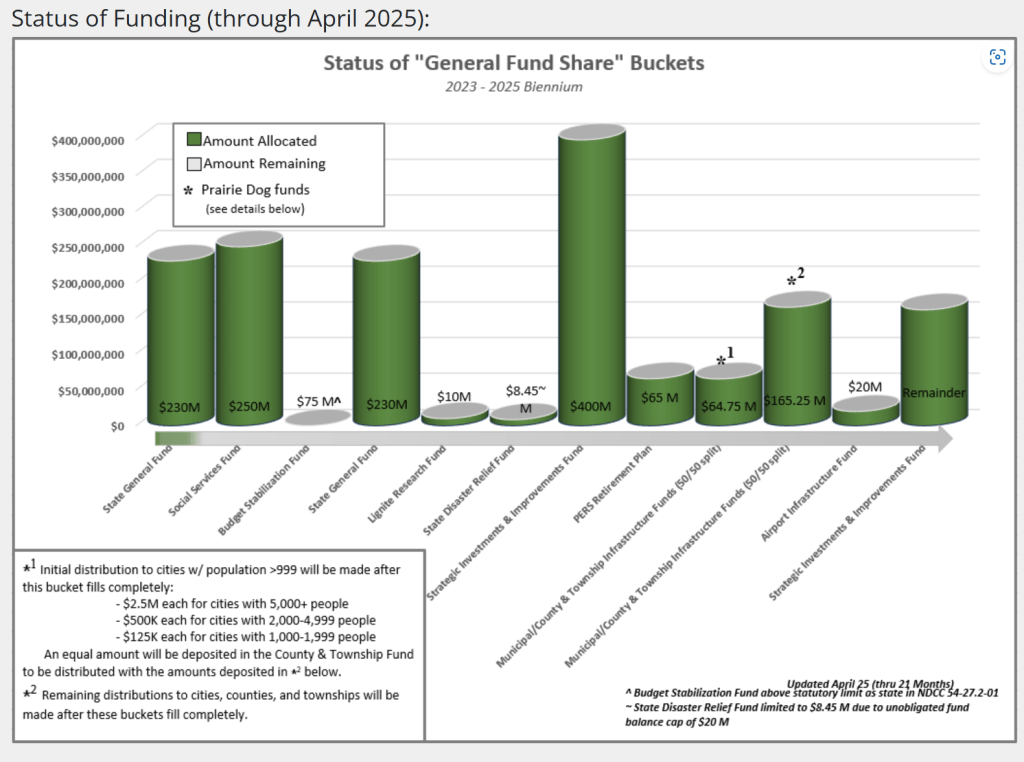
The Prairie Dog bucket got a nice addition in the OMB Budget Bill (HB 1015), increasing it from $170M to $220M.  This is to keep distributions whole if SB 2397 passes. SB 2397 re-defines low-oil producing counties as non-oil producing. There are five counties and 187 townships this would impact. The $50 million in additional Prairie Dog funds in HB 1015 would ensure distributions to cities, counties and townships would not decrease. In addition, House Appropriators decreased the amount deposited into the Strategic Investment and Improvements Fund that sits ahead of the Prairie Dog buckets from $400 million to $270 million. This would decrease the amount of oil and gas production tax revenue that is required to be deposited in other priority buckets prior to reaching non-oil counties, townships and cities. It is important to note that during a recent legislative revenue forecast, the state is predicting that the prairie dog buckets will likely not fill in the 25-27 biennium.

Other important transportation bills that have passed: HB 1444 allows counties to add township roads to the county system if it is determined a local road meets the criteria in the county road system definition.  SB 2183 increases the violation fee of speeding in construction work zones from $80 to $150.  The speed limits must be followed even if construction workers are not present in the construction zone.

The House defeated HB 1407 which would have increased weight limits for vehicles on the state and local roads from 80,000 to 113,000 pounds. The Senate defeated SB 2208, which would have penalized counties/townships that passed an ordinance or policy that exceeded state statute to restrict agriculture or energy infrastructure projects by prohibiting them from receiving Prairie Dog funding.     

PUBLIC SAFETY RELATED

Several priority public safety-related bills are still in play as we enter the second period of the Session, even if they have been amended. NDACo worked with several legislators to introduce bills to address jail funding. HB 1197 and HB 1213 have both been amended but will provide some relief to those counties looking at jail improvement projects.  HB 1197 was turned into a study of correctional needs, and HB 1213 is intended to dedicate $50 million in low-interest loans for jail improvements. HB 1344 was approved to clarify that NDDOCR will reimburse counties for housing state-sentenced inmates when the state system is experiencing overcrowding.

The Attorney General’s Truth in Sentencing bill, SB 2128, which forces violent offenders to serve a greater portion of their sentences in prison, has passed over to the House.

Several bills focused on rewarding those in public safety have found success. HB 1193 has been amended to mirror the Back the Blue Grants approved in the 2023 Session to provide $3.5 million in recruitment and or retention bonuses to local law enforcement and corrections officers.  HB 1419 would allow 9-1-1 dispatchers and EMS to enroll in the NDPERS public safety plan, if their county offers the plan. SB 2093 expands the income tax deduction for retired law enforcement to surviving spouses. The Senate turned SB 1371 into a study of health insurance for retired peace officers.

Here are a few other public safety bills worth noting:

SB 2277: Designates Highway 200 as ND Fallen Peace Officers Highway – FINAL PASSAGE

SB 2098: Improvements to criteria for issuing Silver Alerts – PASSED

SB 2365: Prohibits judges from waiving 24/7 fees – FAILED

FINANCE/ELECTION RELATED

Auditors of course are closely watching the property tax-related legislation and the technical aspects of those bills that will impact budgeting, statements, notices, etc. A success was the defeat of HB 1384 which sought to require that the county auditor be elected, along with the defeat of HB 1306 which would have expanded the number of free hours to respond to open record requests from one to 40 hours. This bill met heavy opposition from county officials. An effort to reduce publication requirement for counties failed in the House with the defeat of HB 1380.

A handful of election-related bills were introduced, all those of concern were defeated:

  • HB 1587: Related to post-election audits and required ballots to be hand counted
  • HB 1287: Established voter registration
  • SB 2178: Required separate ballots for each party for the primary election

PUBLIC HEALTH RELATED

Local public health units will continue to seek an additional $2 million dollars for a total of $10 million in state aid funding in the Department of Health and Human Services Budget, HB 1012. State aid funding is critical, flexible funding assistance to fill gaps and cover the many responsibilities local public health units have that aren’t earmarked through designated funding. This funding increase is especially important with the threat of the state mandating local government budget restrictions.

Two septic system bills were introduced on each side and both passed. HB 1541 moves to the Senate with support from local public health units, the plumbing board and environmental health practitioners. Authority to create rules related to licensing, permitting, and inspecting septic systems lies within the Department of Environmental Quality (DEQ).  SB 2267 places licensing and oversight of septic systems with the plumbing board which continues to oppose “private sewage disposal systems” oversight, stating it is a separate discipline from plumbing.  

Data collection from the Youth Tobacco Survey and Youth Risk Behavior Surveillance System (YRBSS) are at risk in SB 2105 which was passed in the Senate. Currently, these two data sources are the only two of their kind and offer insight into areas such as dietary behaviors, sleep, mental health issues, tobacco/vaping use, safety concerns, and physical activity. Questions for the YRBSS survey are selected through a committee of stakeholders including HHS Public Health, HHS Behavioral Health Division, DPI, DOT, Community Organizations and Regional Education.

Other public health-related bills worth noting:

  • SB 2308: Removes the Onsite Wastewater Technical Review Committee and moves authority to create septic system rules to DEQ – PASSED
  • SB 2281 and HB 1570: Proposed increases to tobacco tax – FAILED
  • SB 2255: Pertains to qualifications, term, and duties of the state health officer – PASSED

OTHER BILLS OF COUNTY IMPORTANCE:

  • HB 1602: Allow political subdivisions to opt out of NDPERS defined contribution plan – PASSED
  • HB 1096: Reduce 9-1-1 service fee to 2.5%, returning additional funds to support 9-1-1 system – FINAL PASSAGE
  • HB 1310: Eliminate fees for defendants, which would have reduced the amount of dollars going into the court improvement grants – FAILED
  • HB 1141: Prohibit state or political subdivisions engaging in activities with member associations that endorse ballot measures – FAILED
  • SB 2039: Property tax exemption for ag storage facilities – PASSED  

There is still a lot of important work to do! For bills that have crossed over, this is the last chance to weigh in to make changes or encourage their passage or defeat. If the bills are altered by the second chamber at all, they may go to conference committees where lawmakers from both sides will work on a compromise.

Weekly Report for March 10-14th

Two of the major property tax relief / reform bills had hearings Tuesday. HB 1168 buys down 10 mills of property taxes using the school funding formula and places a 3% cap on dollars levied for all political subdivisions except schools. NDACo suggested a restriction based on the Consumer Price Index plus 2% would be preferred over a 3% flat cap. HB 1168 does allow to carry over unused cap to the next year and allows for a vote to exceed the limitation. The Senate Finance & Taxation committee also received testimony on HB 1575 which reduces the tax rate on all property classes including centrally assessed and includes a 3% cap on taxable valuation. While the bills vary in how they restrict local government they both provide relief to all property taxpayers, which is appealing to some lawmakers. During both hearings the bill sponsors did suggest amendments. The committee did not act on these bills as the other major property tax bill is scheduled for Monday. HB 1176 provides $1450 in relief for primary residents only through the primary residence credit. It also includes a 3% cap on dollars levied but also allows for a vote to exceed the cap and allows for carry-over. HB 1176 will be heard Monday, March 17th at 9 a.m. in the Senate Finance & Tax committee. It is uncertain at this point if the committee will want to amend any of the bills and choose one as the favorite to pass out of the Senate. NDACo will be monitoring the committee work on these bills very closely.

Other important action this week:

  • NDACo testified in opposition to SB 2039 which would provide a property tax exemption to Agriculture storage facilities on the basis that these tax exemptions shift the tax burden to other property taxpayers.
  • SB 2365 sought to prohibit judges from waiving 24/7 fees, an action that is being done in some counties and impacts the associated costs for this program which is intended to be self-funded. SB 2365 had a hearing, received a Do Not Pass recommendation and was defeated in the House. The bill had been supported by the Sheriffs.
  • HB 1096 which decreases the 911 service fee to provide additional revenues to support the 911 program received final passage in the Senate.
  • SB 2098 also received final passage and changes the criteria used to issue Silver Alerts.
  • SB 2183 which increases fines in construction zones was passed out of committee but amended to only include the fine when workers are present in a construction zone. 
  • HB 1518 relating to rotary traffic islands (round abouts) came out of committee with a DNP as it is a duplicate bill of SB 2371, which already passed both houses.
  • HB 1153, which passed both houses, clarifies exemptions for one-call notices for normal maintenance of paved roads as long as it does not extend deeper than existing pavement and normal surfacing of gravel roads, as long as the maintenance does not involve the road ditch.
  • SB 2281 which would have increased the tobacco tax, failed in the House.

Click here to view the hearing schedule of bills NDACo is tracking

Property Tax Packages in Senate’s Hands

As we have now made it halfway through the 2025 legislative session much of the smoke and noise has gone away and we have a slightly better understanding of what Legislators are thinking when it comes to property tax relief and restrictions. As you might remember we started the session with 60 different bills dealing with property taxes, but we are now down to just a handful. View a summary of the property tax proposals here.

The remaining bills vary in how they deliver relief from providing a primary residence credit (HB 1176), to buying down school mills (HB 1168) and reducing tax rates (HB 1575). All three of these bills restrict local government’s ability to raise taxes. At this point, it seems bills that limit property values (HB 1575 & HB 1534) are not gaining much traction in the Senate but bills that provide either a property tax credit for primary residence and/or property tax “buydown” for school mills are gaining support.

Two of the bills will be heard this week. HB 1168 and HB 1575 will both be heard Tuesday. HB 1176 was previously scheduled for Monday morning but has been cancelled over the weekend. We predict HB 1176 will be heard the week of March 17th. HB 1176 & HB 1575 contain significant tax relief at $500 million and $703 million. All three bills contain limitations to local budgets. In other words……CAPS. The legislature has been solidly in the 3% camp so far. Exemptions to the 3% are provided in these bills but they are not all the same.

Although we believe the legislature will ultimately regret going down the cap road it appears CAPS are on their way. Because of the strong position of the legislature to restrict local spending, the strategy has now shifted to asking for lawmakers to lighten the cap to avoid severe consequences of diminished local services. Click here to view the list of what a 3% cap on levies means for each county.

Ath the direction of the ND County Commission Association legislative call, NDACo will be supporting any bill that provides relief for taxpayers. However, we are going to suggest that a flat 3% is not the way to go and instead they should consider an indexed cap based on the Consumer Price Index (CPI) + 2% to account for high inflation years like we all just recently experienced. We would also acknowledge there still would have to be an overall cap in this scenario so we are suggesting we would not go higher then 6% nor could we go lower than 2% in craze inflation or deflation times respectively.

These are tough decisions, and taxation policy is not easy. The chairman indicated they will hear all these bills before acting on them. It is unknown if they will work to merge some of the concepts into one bill or choice one to recommend passage. Regardless, we encourage you to review the bills and reach out to your legislators to let them know your thoughts. Now is the time!

Click here to view the schedule of bills NDACo is tracking for March 10-14.

*iMPORTANT: hb1176 appears on schedule but it has been cancelled

Legislators Hit Crossover Break

This is a quick update on a short but important week at the Capitol. Lawmakers have hit the crossover deadline where bills need to be acted on by the chamber they were introduced in. The Senate wrapped up their work Tuesday afternoon and the House ended at 10:30 p.m. Tuesday evening. The Legislative Session will resume Wednesday, March 5th. 1,082 bills and resolutions were submitted during this 2025 Session, the most since 2009. Watch for a NDACo crossover report to come in next few days.

Property Tax Bills

The big anticipation this week was over how the House and Senate would vote on the several property tax relief and reform bills. The two bills in the Senate failed, while the House passed on three bills with varying options to provide relief and reform. Click here to view summary chart of active bills proposing relief and reform.

Rep. Mike Nathe speaks on HB 1176
  • SB 2363 – Focused on providing relief to Agriculture taxpayers only. It went to Appropriations with a 30 mill reduction using the school funding formula, The Appropriations committee decreased it to a 15 mill reduction and a floor amendment introduced as the bill was before the full Senate further reduced the relief to 7 mill reduction. Failed 23-23.
  • HB 1176 – Provides $1450 in relief to property owners through the primary residence credit. The bill also includes a 3% cap on levies but allows taxing districts to exceed the cap by a specific percentage if approved by a majority vote in the general election. Emergency levies are also exempt from the cap. Taxing districts can also carry over any unused cap, once within 5 years. The bill also includes an increase in the homestead tax credit and renter’s refund. Passed 81-10
  • HB 1575 – Provides property tax relief to all property classes (Residential, Agriculture, Commercial) by reducing the tax rate. The bill also increases the threshold to qualify for the homestead tax credit as well as increases the renter’s refund. The bill includes a 3% cap on increase of taxable valuation. Taxing districts can, with majority voter approval in the general or primary, increase the mill levy authority for up to 6 years. The vote must be for a specific number of mills, state the intended purpose and identify for how long. Passed 86-5
  • HB 1168 – Provides a 10 mill buy-down using the school funding formula for all properties. Includes a 3% cap on taxes levied for all taxing districts except school districts. Taxing districts can carry over unused cap to the next year. Taxing districts can exceed the limitation with a supermajority of 60% of the vote in the general or primary for no more than 5 years at a time. Passed 88-3.
Rep. Mike Lefor addresses House members

Other Bills worth highlighting that were acted on this week:

  • SB 2012 – DOT Budget – Passed 47-0. As described in last week’s report, this bill includes new funding for counties, townships and cities. The greatest policy change is dedicating 100% of the motor vehicle excise tax to roads and bridges. Three other Senate bills that included road funding were killed as portions of those bills were merged into SB 2012.
  • SB 2281 – Tobacco Tax Increase – Passed 26-21.
  • SCR 4023 – Vote to Repeal 1 mill for State Medical Center – Failed 21-26.
  • SB 2128 – Attorney General Truth in Sentencing – Passed 28-18.
  • HB 1213 – Low Interest Loans for Jail Improvements – Passed 64-28.

Legislative Council does have a schedule for next week published.

Click here to view or download the schedule.