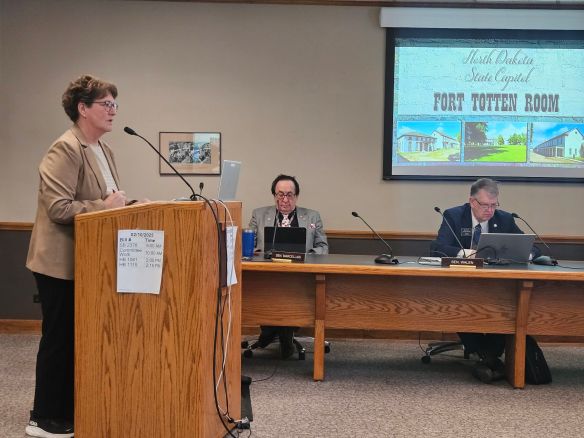
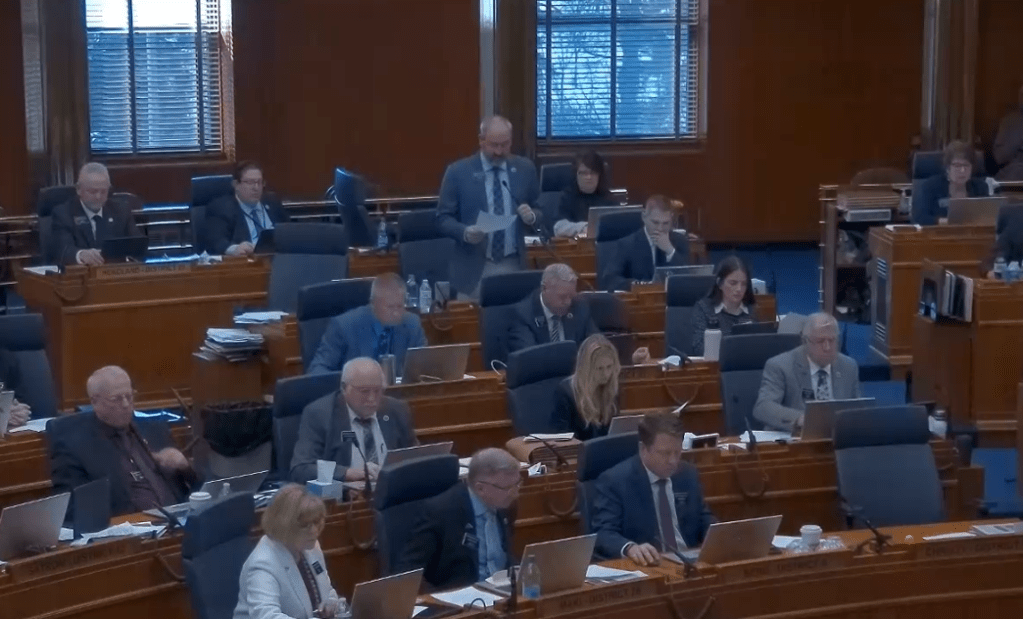
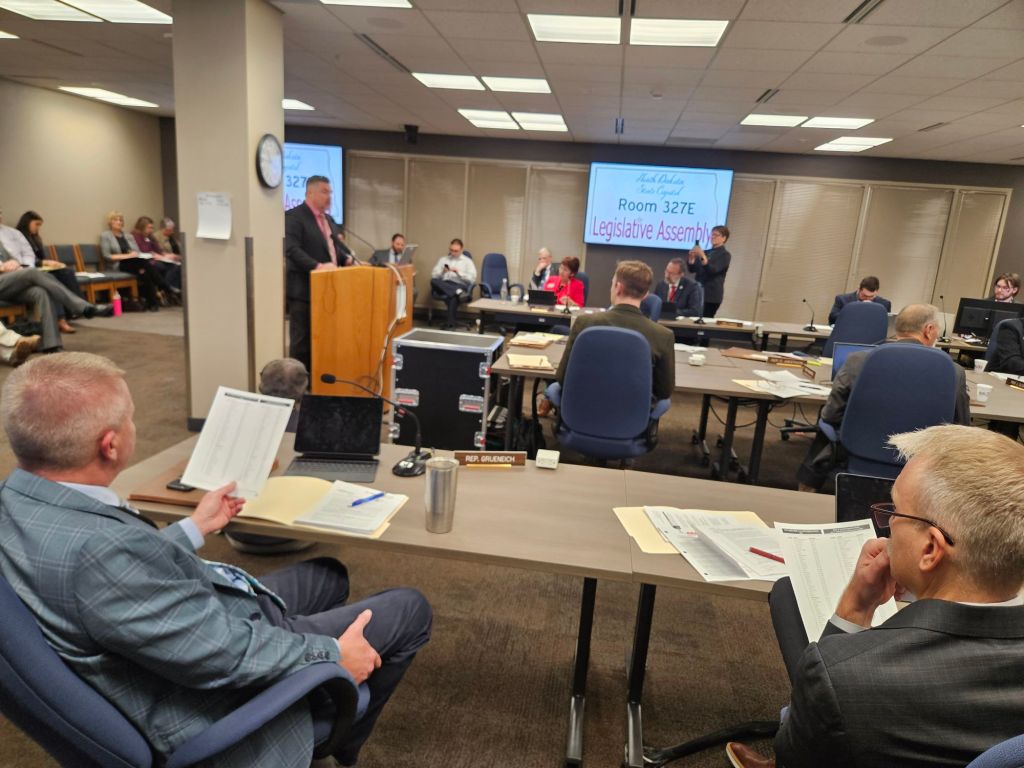
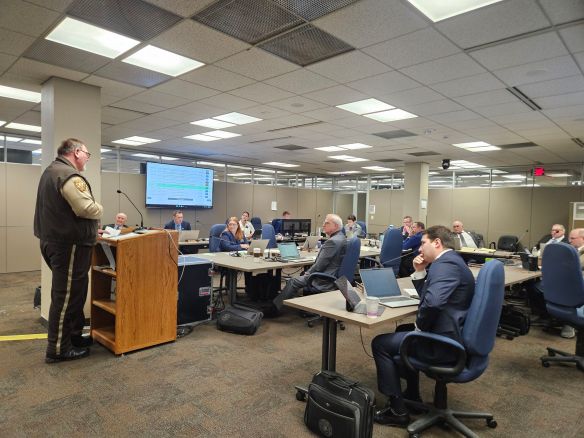
Two of the major property tax relief / reform bills had hearings Tuesday. HB 1168 buys down 10 mills of property taxes using the school funding formula and places a 3% cap on dollars levied for all political subdivisions except schools. NDACo suggested a restriction based on the Consumer Price Index plus 2% would be preferred over a 3% flat cap. HB 1168 does allow to carry over unused cap to the next year and allows for a vote to exceed the limitation. The Senate Finance & Taxation committee also received testimony on HB 1575 which reduces the tax rate on all property classes including centrally assessed and includes a 3% cap on taxable valuation. While the bills vary in how they restrict local government they both provide relief to all property taxpayers, which is appealing to some lawmakers. During both hearings the bill sponsors did suggest amendments. The committee did not act on these bills as the other major property tax bill is scheduled for Monday. HB 1176 provides $1450 in relief for primary residents only through the primary residence credit. It also includes a 3% cap on dollars levied but also allows for a vote to exceed the cap and allows for carry-over. HB 1176 will be heard Monday, March 17th at 9 a.m. in the Senate Finance & Tax committee. It is uncertain at this point if the committee will want to amend any of the bills and choose one as the favorite to pass out of the Senate. NDACo will be monitoring the committee work on these bills very closely.
Other important action this week:
NDACo testified in opposition to SB 2039 which would provide a property tax exemption to Agriculture storage facilities on the basis that these tax exemptions shift the tax burden to other property taxpayers.
SB 2365 sought to prohibit judges from waiving 24/7 fees, an action that is being done in some counties and impacts the associated costs for this program which is intended to be self-funded. SB 2365 had a hearing, received a Do Not Pass recommendation and was defeated in the House. The bill had been supported by the Sheriffs.
HB 1096 which decreases the 911 service fee to provide additional revenues to support the 911 program received final passage in the Senate.
SB 2098 also received final passage and changes the criteria used to issue Silver Alerts.
SB 2183 which increases fines in construction zones was passed out of committee but amended to only include the fine when workers are present in a construction zone.
HB 1518 relating to rotary traffic islands (round abouts) came out of committee with a DNP as it is a duplicate bill of SB 2371, which already passed both houses.
HB 1153, which passed both houses, clarifies exemptions for one-call notices for normal maintenance of paved roads as long as it does not extend deeper than existing pavement and normal surfacing of gravel roads, as long as the maintenance does not involve the road ditch.
SB 2281 which would have increased the tobacco tax, failed in the House.
As we have now made it halfway through the 2025 legislative session much of the smoke and noise has gone away and we have a slightly better understanding of what Legislators are thinking when it comes to property tax relief and restrictions. As you might remember we started the session with 60 different bills dealing with property taxes, but we are now down to just a handful. View a summary of the property tax proposals here.
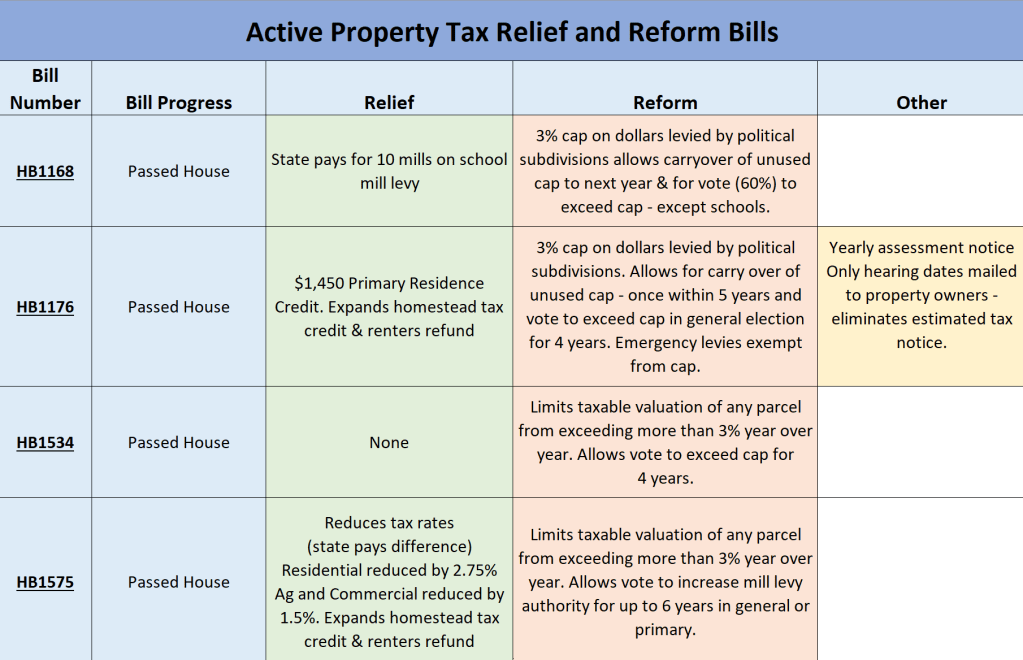
The remaining bills vary in how they deliver relief from providing a primary residence credit (HB 1176), to buying down school mills (HB 1168)and reducing tax rates (HB 1575). All three of these bills restrict local government’s ability to raise taxes. At this point, it seems bills that limit property values (HB 1575 & HB 1534) are not gaining much traction in the Senate but bills that provide either a property tax credit for primary residence and/or property tax “buydown” for school mills are gaining support.
Two of the bills will be heard this week. HB 1168 and HB 1575 will both be heard Tuesday. HB 1176 was previously scheduled for Monday morning but has been cancelled over the weekend. We predict HB 1176 will be heard the week of March 17th. HB 1176 & HB 1575 contain significant tax relief at $500 million and $703 million. All three bills contain limitations to local budgets. In other words……CAPS. The legislature has been solidly in the 3% camp so far. Exemptions to the 3% are provided in these bills but they are not all the same.
Although we believe the legislature will ultimately regret going down the cap road it appears CAPS are on their way. Because of the strong position of the legislature to restrict local spending, the strategy has now shifted to asking for lawmakers to lighten the cap to avoid severe consequences of diminished local services. Click here to view the list of what a 3% cap on levies means for each county.
Ath the direction of the ND County Commission Association legislative call, NDACo will be supporting any bill that provides relief for taxpayers. However, we are going to suggest that a flat 3% is not the way to go and instead they should consider an indexed cap based on the Consumer Price Index (CPI) + 2% to account for high inflation years like we all just recently experienced. We would also acknowledge there still would have to be an overall cap in this scenario so we are suggesting we would not go higher then 6% nor could we go lower than 2% in craze inflation or deflation times respectively.
These are tough decisions, and taxation policy is not easy. The chairman indicated they will hear all these bills before acting on them. It is unknown if they will work to merge some of the concepts into one bill or choice one to recommend passage. Regardless, we encourage you to review the bills and reach out to your legislators to let them know your thoughts. Now is the time!
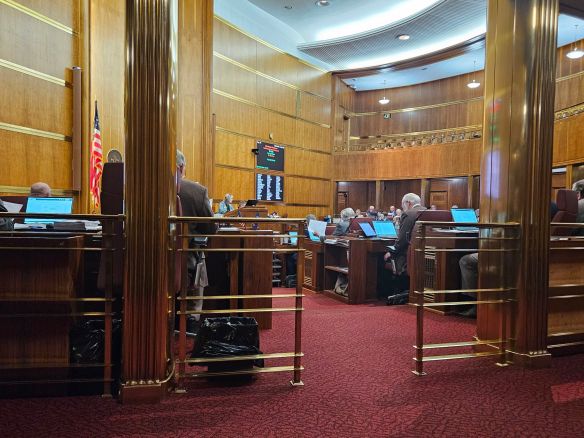
This is a quick update on a short but important week at the Capitol. Lawmakers have hit the crossover deadline where bills need to be acted on by the chamber they were introduced in. The Senate wrapped up their work Tuesday afternoon and the House ended at 10:30 p.m. Tuesday evening. The Legislative Session will resume Wednesday, March 5th. 1,082 bills and resolutions were submitted during this 2025 Session, the most since 2009. Watch for a NDACo crossover report to come in next few days.
Property Tax Bills
The big anticipation this week was over how the House and Senate would vote on the several property tax relief and reform bills. The two bills in the Senate failed, while the House passed on three bills with varying options to provide relief and reform. Click here to view summary chart of active bills proposing relief and reform.
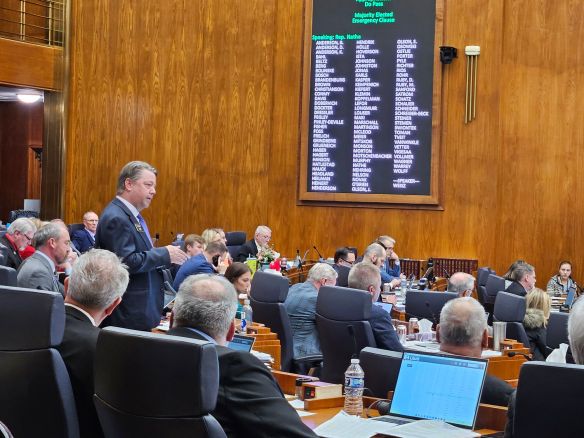
Rep. Mike Nathe speaks on HB 1176
SB 2363 – Focused on providing relief to Agriculture taxpayers only. It went to Appropriations with a 30 mill reduction using the school funding formula, The Appropriations committee decreased it to a 15 mill reduction and a floor amendment introduced as the bill was before the full Senate further reduced the relief to 7 mill reduction. Failed 23-23.
HB 1176 – Provides $1450 in relief to property owners through the primary residence credit. The bill also includes a 3% cap on levies but allows taxing districts to exceed the cap by a specific percentage if approved by a majority vote in the general election. Emergency levies are also exempt from the cap. Taxing districts can also carry over any unused cap, once within 5 years. The bill also includes an increase in the homestead tax credit and renter’s refund. Passed 81-10
HB 1575 – Provides property tax relief to all property classes (Residential, Agriculture, Commercial) by reducing the tax rate. The bill also increases the threshold to qualify for the homestead tax credit as well as increases the renter’s refund. The bill includes a 3% cap on increase of taxable valuation. Taxing districts can, with majority voter approval in the general or primary, increase the mill levy authority for up to 6 years. The vote must be for a specific number of mills, state the intended purpose and identify for how long. Passed 86-5
HB 1168 – Provides a 10 mill buy-down using the school funding formula for all properties. Includes a 3% cap on taxes levied for all taxing districts except school districts. Taxing districts can carry over unused cap to the next year. Taxing districts can exceed the limitation with a supermajority of 60% of the vote in the general or primary for no more than 5 years at a time. Passed 88-3.
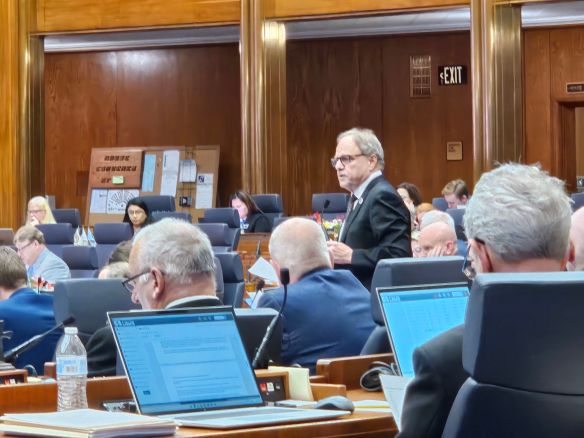
Rep. Mike Lefor addresses House members
Other Bills worth highlighting that were acted on this week:
SB 2012 – DOT Budget – Passed 47-0. As described in last week’s report, this bill includes new funding for counties, townships and cities. The greatest policy change is dedicating 100% of the motor vehicle excise tax to roads and bridges. Three other Senate bills that included road funding were killed as portions of those bills were merged into SB 2012.
SB 2281 – Tobacco Tax Increase – Passed 26-21.
SCR 4023 – Vote to Repeal 1 mill for State Medical Center – Failed 21-26.
SB 2128 – Attorney General Truth in Sentencing – Passed 28-18.
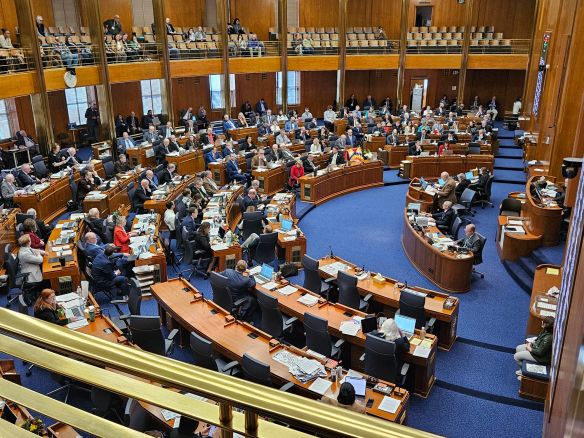
It was a fierce week for lawmakers in terms of acting on bills. The House held several evening floor sessions and Appropriations committee held evening sessions as well. They are on pace to hit the crossover mark Wednesday. Crossover is the legislative deadline for when bills need to be acted on in the chamber of origination. Bills that are still alive will then move over to the other chamber and have a hearing and be voted on by the committee and chamber. So, House bills passed by house members will now move to the senate and vice versus. They will resume session Wednesday, March 5th.
There are a number of priority items to keep watch for in the next few days that will come up for votes. The House Appropriations committee Friday evening gave three property tax relief/reform measures HB 1176, HB 1575 & 1168 do pass recommendations. The major change appropriators made to HB 1176 is shortening the years a vote to exceed the cap is good for from 10 to 4 years. The three House bills each provide the relief using different vehicles from a Primary Residence Credit (1176), reduction in tax rates (1575) and school funding (1168). All three include a cap or revenue limitation for political subs. These bills could be voted on Tuesday or Wednesday. The Senate also has two property tax relief/reform bills waiting to be acted on. SB 2378 has a DNP and SB 2363, which uses the school funding formula to provide relief, has a Do Pass recommendation. Click here to view a list of property tax relief/reform bills that are still active.
Property Tax related, Governor Armstrong signed his first bill, SB 2201, which fixes an oversight related to trusts and the primary residence credit approved by the legislature in 2023. The bill has an emergency clause which takes effect immediately. Primary residences now owned by trusts are eligible for the PRC and are able to retroactively apply for the 2024 credit.
HB 2013 which seeks to provide $50 million in low-interest loans dedicated to jail improvements was passed out of House Appropriations with a Do Not Pass recommendation. This bill along with HB 1176 were introduced to assist counties planning jail expansions. That bill was amended into a study of correctional facility needs.
SB 2128, the Attorney General’s Truth in Sentencing bill was sent out of appropriations with a do not pass recommendation.
The Department of Transportation Budget, SB 2012, got a major rework in Senate Appropriations. The committee merged three bills with proposals for local road funding into the DOT budget. The committee’s actions build upon 2023 legislation to provide more reliable funding for to address state and local government road needs. A big move in policy is dedicating 100% of the motor vehicle excise tax ($360 million) to roads. The Senate plan would also dedicate 1% of Legacy Earnings to provide a total of $447 million into the flexible transportation fund. 50% of those funds would be for state DOT projects and the other 50% ($223 million) to local governments through six different buckets.
HB 1541 was amended to allow local public health units to permit and inspect septic systems but not license septic system installers. The authority to create rules related to licensing, permitting, and inspecting septic systems lies within DEQ’s authority. This bill creates the “Environmental Quality Advisory Committee” which has 7 members, 1 ex officio member from DEQ, 3 licensed installers, and 3 local public health members. The committee is tasked with recommended standards and procedures relating to licensing, permitting and inspections of systems. Local public health and environmental health practitioners support this bill which is still on the Floor for final passage.
With the desire to move the bill through committee, SB 2267 received a Do Pass with amendments. One amendment removed the section that was inserted into public health core competencies of Century Code stating LPHU had no authority over septic systems. Additional discussion without resolution included ultimate responsibility authority through DEQ or the plumbing board. Consideration of the amendments are on the Senate Floor.
SB 2308 passed through committee with amendments. Among the many state boards and committees being reviewed in this bill is the Onsite Wastewater Technical Review Committee established in the 2023 session. As amended, authority to create septic system rules would move to DEQ.
Here’s a highlight of other bills of importance that were acted on this week:
HB 1382 – Gas tax increase of 3 cents to counties, townships & cities ($42 million in additional revenue which includes $18 million for counties) PASSED 58-35
HB 1193 – Law enforcement appreciation grants amended to $3.5 million similar to Back the Blue Grants approved in 2023 Session. PASSED 78-14
HB 1602 – Allows political subs in NDPERS to opt out of defined contribution plan and fund own plan. PASSED
SB 2208 – Prohibited counties limiting energy development from receiving Prairie Dog funds. FAILED
HB 1306 – Expanded free hours for open records requests to 40 hours. FAILED
HB 1587 – Election related including hand count post-election audit. FAILED
The following information was shared with lawmakers in the NDACo Common Ground e-newsletter.
There is a great deal of pressure this session to approve both property tax relief and reform. This is no easy task as there are many strong opinions on how best to accomplish this. As you know, counties are dependent on property taxes to pay for local services. Half of the property taxes collected are dedicated to roads and public safety. These local services are important to the safety and quality of life of North Dakota citizens. What citizens don’t want is less law enforcement keeping their community safe and neglected roads. This scenario could be a reality if counties are limited in how much revenue they can generate to keep services running. In fact, budgets are set based on needs and citizen input which led to counties cutting taxes 1.2% in 2022. Furthermore, 22 counites in 2023 reduced mill rates and eight of those counties lowered the dollars they levied.
County commissioners are the closest level of government to the people. It is important to keep local control the focus of any reform measures you consider. Discussion related to caps has counties concerned. A cap will directly limit local control and the ability for local government leaders to respond to their community.
Counties are not equal. They are different in geographical size, population, property tax base, and economic factors. A cap, regardless of the level, means different things based on a county’s budget and the value of a mill.
A 3% cap on property tax levies in Sioux County would provide $20,000 in additional funds for all county operations, that’s the low end. For comparison, the median amount generated by a 3% cap would generate $98,000 additional revenue for a county.
Half of the counties in the state will generate less.
Most of those counties have little to no ability to generate revenue other than from property taxes.
A 3% cap would generate more than $500,000 in the state’s four largest counties.
Existing property tax laws already limit the revenue that can be raised from county property taxes.
Four counties are at their mill levy maximum for their general fund.
Four additional counties are within five mills of reaching the maximum limit for their general fund.
There are 31 counties in the state where one mill generates less than $50,000.
There are numerous costs a county can’t control including:
State unfunded mandates
Road maintenance
Fuel
Road equipment
Health insurance premiums
Mandated valuation increases
Criminal law changes
WHEN LOOKING AT REFORM ISSUES, WE ASK LEGISLATORS TO CONSIDER:
Budget restrictions remove local boards’ discretion to respond. It is the responsibility of local boards to evaluate funding sources and weigh how to pay for mandated services along with citizens’ requests. In addition, there are investments counties need to make to support infrastructure needs due to population growth and industrial expansions. Board members know the needs of their county and are elected to make those decisions.
Citizens should have options to decide if a cap is appropriate for their county. Providing an opportunity for citizens to vote to opt-out or exceed a cap allows for LOCAL CONTROL.
Citizens have overwhelmingly approved of recent county measures seeking tax increases to address specific county needs like roads and public safety.
Taxpayers ultimately should have a voice on whether they support paying more for services.
Emergency levies are already restricted on how they can be used and the level of dollars allowed. This levy should be exempt from caps. Local governments need the ability to rebuild the fund to address future emergency events. Situations where a county would need to utilize funds from the emergency levy often can’t wait two years for a vote.
If caps of any kind are to be included in tax reform policy measures, the legislature needs to discontinue passing additional costs to local government of which they have no control.
Property tax exemptions shift the tax burden to other taxpayers. An individual pays more property taxes when a property tax exemption is provided to someone else. For property tax fairness, we encourage the legislature to refrain from passing any new exemptions and to evaluate property tax exemptions previously approved by the state that can or should be funded by the state versus passed on to taxpayers.
ENDING THOUGHT…
It is critical that property tax reform measures allow for flexibility and do not hinder growth. Local control is imperative. Citizens should have a say on the services they want in their community and have an opportunity to support paying more for those services.
Legislature Narrows Down Property Tax Relief and Reform Measures
It was a busy week of committee work as policy committees spent their time wrapping up their work on bills they have heard and passed out of committee. The first priority for policy committees was acting on bills with appropriations as the deadline for those bills to get referred was Monday. The Finance & Tax committees passed out the property tax relief and reform bills that have been proposed. We now have a greater understanding of which options are moving forward. The options out there vary greatly on how they propose to deliver relief and reform.
Here is a summary of the bills that have received Do Pass committee recommendations and have been referred to Appropriations. We expect that they could be voted on this week.
HB 1176 – Relief: $1450 Primary Residence Credit. Reform: 3% cap on property tax dollars. Allows counties to exceed or opt out of the cap with a vote in the general or primary election. Will be heard in House Appropriations Monday 2/17 at 3:00.
HB 1168 – Relief: Provides 10 mills of relief through school funding formula. Reform: 3% cap on property tax dollars. Allows carryover of unused cap to next year. Allows counties to exceed the cap with a 60% vote in a regular or special election.
HB 1534 – Reform: 3% cap on taxable values, allows to exceed % with a vote.
HB 1575 – Relief: Reduces tax rates for residential, agricultural, and commercial. Reform: 3% cap on taxable values. Cap can be exceeded by a defined % with approval by the voters.
SB 2363 – Relief: 60 mill reduction for residential, commercial and centrally assessed, 30 mill reduction for agriculture land using school funding formula.
SB 2378 – Reform: CPI cap, can be exceeded by defined % with voter approval of two-thirds qualified electors. No committee action yet.
Other important legislative highlights from the week:
SB 2201: Property Tax relief related – retroactive to allow for trusts to receive Primary Residence Credit – FINAL PASSAGE
HB 1382: Increases gas tax 3 cents for counties, cities & townships – was defeated on house floor, reconsidered and passed – rereferred to Appropriations
HCR3012: Resolution to put on ballot repeal of one mill for state medical center – FAILED
HB 1602: Allows political subs to opt out of NDPERS defined contribution plan – Do Pass recommendation – expect this on the House floor Monday,
HB 1213: $50 million in Infrastructure Revolving Loan Fund for Jail Improvements – PASSED
HB 1197: Amended to study jail needs – PASSED
HB 1306: Expanded free hours allowed for open records requests – Do Not Pass recommendation
HB 1193: Law Enforcement Grants amended in House Appropriations to mirror Back the Blue grants from 2023 Session for local law enforcement & corrections officers – Do Pass Recommendation
Public Health Day at the Capitol
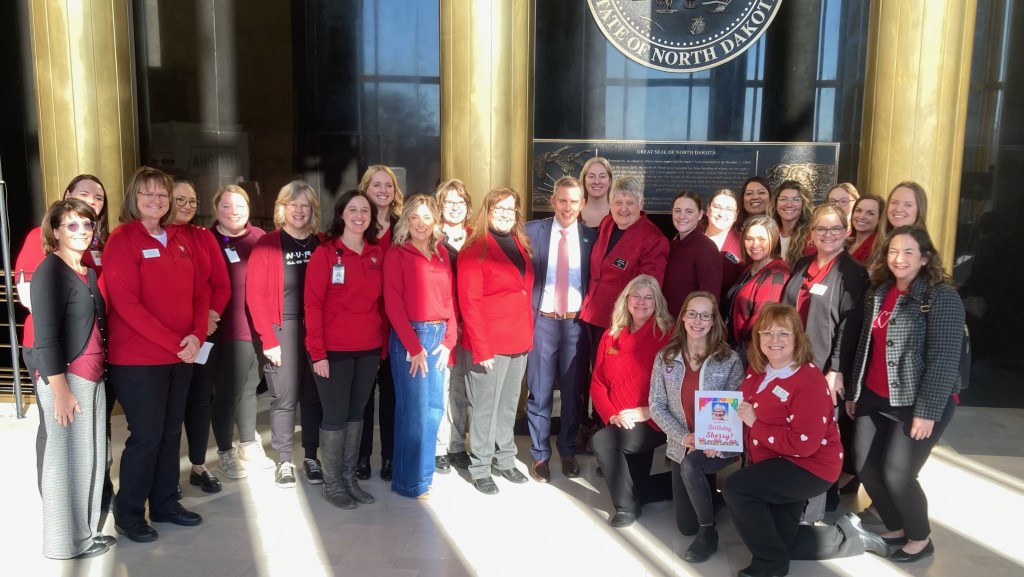
SACCHO local public health members teamed up with the North Dakota Public Health Association (NDPHA) and the North Dakota Department of Health and Human Services (NDHHS) partners for Public Health Day at the Legislature. Held in the Capitol’s Memorial and Legislative Halls, the event showcased public health initiatives, and the work public health professionals do to protect and improve the health of North Dakota communities. Public health trivia and Plinko were among the activities enjoyed by Legislators.
Local Government Capitol Connection THIS WEEK!
There is still time to register for the upcoming Local Government Capitol Connection Feb. 18-19th at the Bismarck Event Center. NDACo is partnering with other associations representing cities, townships, schools and parks to bring all local political sub leaders together for legislative updates. We hope to see you there! Click here for more information.
In a somewhat rare move, House members Tuesday requested to debate amendments on HB 1176. HB 1176 is the property tax relief and reform bill sponsored by Rep. Nathe to provide a $1450 primary residence credit and caps local government limits property taxes at 3% growth. More detail about what is included in the bill was provided in a previous legislative blog post.
Rep. Ben Koppelman of West Fargo wanted to debate amendments included in two specific sections of the bill. He criticized the flexibility provided to political subs in relation to the cap on property tax revenues. The amendments he singled out for debate allow political subdivisions to vote to exceed the cap for two years as well as the ability for counties and cities to ask for voter approval to override the cap, good for 10 years. After plenty of debate, House members voted to keep the flexibility to exceed and opt out of the cap in HB 1176.
The other amendment debated was a section added to include income tax relief, increasing the income threshold for the bottom, zero bracket. The House did vote to remove that section of the bill.
HB 1176 will now go to House Appropriations before returning to the House Floor for another vote on the bill in its entirety. We encourage you to let your Representatives know the reasons why any reform measures need to allow for some level of local control.
Perhaps the biggest news of the week is the House Finance & Tax Committee acting on one of the major property tax relief / reform bills. The committee passed an amended version of HB 1176 which is sponsored by Rep. Nathe and Governor Armstrong highlighted elements of the bill in his State of the State Address. HB 1176 will go to the House Appropriations committee either late this week or next, then it will be voted on the House floor. While caps still remain in this bill, NDACo was able to make suggestions that were included in the amendment that help improve the bill – including votes to exceed the cap good for 2 years and the option for counties and cities to over-ride the cap with voter approval good for 10 years. The approved amendments are not posted online yet but here is a summary of what is included in the bill:
Primary Residence Credit: $1450 maximum
Assessment Notice: Mailed in spring to all property owners, includes true & full value of each parcel for current & previous year and date, time & location of board of equalization meetings.
Budget Hearing Notice: Mailed in August, includes date, time, & location of budget hearings of taxing entities. All other information included on past estimated tax notices is removed.
Cap on Property Taxes Levied: The levy may not exceed the greater of the base year levy or the adjusted year levy increased by 3%. The “base year” levy is the highest amount levied in preceding three years. The “adjusted year” levy is the amount levied in dollars the preceding year plus new growth. Cap is on total property taxes levied.
Unused Cap Carryover: Can be used once within 5 years.
Allows for 3% Cap Exemptions:
Emergency Levy exempt from 3% cap
Allows taxing districts to exceed 3% cap with majority vote in general or primary or 60% majority at a special election.
County or City can be excluded from 3% cap for 10 years with majority vote at general or primary election.
Homestead Tax Credit: Amended to stay at level currently in state law – which was expanded in 2023.
Income Tax Relief: Increases the income for the bottom zero bracket.
The sections of the bill related to the primary residence credit have an emergency clause, meaning the increased amount of the PRC would take effect for 2025.
The House Finance & Tax Committee will be working on other Tax bills with appropriations Monday. They have no other hearings scheduled. The Senate Finance & Tax Committee will be doing the same in between hearings. Monday is the deadline to get bills with an appropriation attached out of committee.
SB2201: Allows primary residences owned by “qualifying trusts” to retroactively apply for the tax year 2024 credit. Amended bill allows applications no later than May 1, 2025. Amended bill passed House Finance & Tax Committee and was rereferred to Appropriations. This bill also includes an Emergency Clause.
Transportation Related:
HB 1382: Special Fuel Excise Taxes for County/Township Road Fund – creates a new fund for County, City, Township Road Fund ($0.03 gas tax) NDACE and NDACo provided testimony in support of bill.
HB 1453: Prohibits state and political subs from doing business with natural asset companies. NDACo opposed the bill as there was no clear definition of a natural asset and included unintended consequences of counties no longer being able to purchase wetland credits. Requested to have clarification in the bill to exempt wetland credits and bill sponsor was open to making the change.
SB 2317: Revocation of Township Zoning Authority – township may reacquire zoning authority from county. Committee approved amendment that townships adopt a comprehensive plan (zoning). No committee action was taken.
SB 2371 & HB 1518: Rotary Traffic Islands (Round Abouts) – both bills passed out of committees to remove the signaling requirement in a round about.
Law Enforcement Related
HB 1193: Law Enforcement Appreciation Grants – as introduced the bill was $8.5 million and sought to provide a $6,000 bonus for all peace officers and state correctional officers who have been with their agency for 4 or more years. The bill received a DNP recommendation but passed the floor. It will be heard in House Appropriations Monday. We expect the bill to be amended in Appropriations to mirror the Back the Blue Grant passed during the 2023 Session.
HB 1613: Restricted the use of drones & robots. The law enforcement community had heavy opposition to the bill. The committee amended it to remove the suggested language and to insert robots into the code relating to limitations of unmanned aircraft for surveillance.
HB 1310: This bill eliminates fees for defendants but in turn repeals the court improvement grants. NDACo testified on the importance of the court improvement grants and that a new funding source will need to be identified.
SB 2365: Addresses when 24/7 fees are waived by Judges. An amendment prohibits Judges from waiving these fees.
HB 1344: Clarifies that when NDDOCR is over capacity and utilizing county / regional jail facilities they will pay starting 7 days after sentencing/notification to NDDOCR. Passed the House Judiciary committee 12-0.
HB 1197 & HB 1213 were two jail related bills seeking state support for Jail Improvements. Both bills were amended and will more than likely be voted on in the House early this week. HB 1197 was changed into a study of current and projected correctional needs and costs. HB 1213 was amended to expand access to the infrastructure revolving loan fund and earmarking $50 million specifically for jail improvements, expansions or new construction.
Other Bills of Importance:
HB 1306: relates to open record requests and proposes to expand the number of hours for free from one hour to 40 hours, for one requester per year if they are a North Dakota resident. This bill met heavy opposition from county folks. Testimony was submitted and provided by NDACo along with commissioners, recorders, auditors, state’s attorneys and Sheriffs.
Septic systems permitting and regulation is the seen in three bills this session.
HB 1541 was initially voted out of the Energy and Natural Resources Committee with a Do Not Pass. The bill was re-considered and an amendment removing the fiscal note was adopted. Additional work on the bill and its amendment is in progress. This bill is supported by local public health, DEQ and the State Plumbing Board.
Addressing public health units to adopt an onsite wastewater recycling treatment guide, SB 2308 received neutral testimony from local public health unit Committee members stating the Committee accomplished what it can and the guide is ready to move to the Department of Environmental Quality.
Standing in opposition of SB 2267, local public health units, environmental health practitioners and the State Plumbing Board reject the removal of local public health input for septic systems which poses significant risks to public health and environmental safety in North Dakota.
The House Finance & Tax Committee heard several additional property tax relief and reform bills that varied in methods of tackling this complex issue. Here is a list of many of the bills heard:
HB 1289 – Partial property tax exemption for providing in-home care – FAILED
HB 1474 – Evaluates property taxes based on square footage
HB 1586 – Increases primary residence credit to $5000, eliminates foreclosures on delinquent taxes
HB 1559 – Shifts the definition of taxable valuation from a direct percentage of the current year’s true and full to a rolling average of three years
HB 1560 – Tax exemption for those who live in home longer than 30 years.
HB 1534 – 3% cap on assessed values for taxing purposes, allows for vote to override
HB 1575 – Reduces tax rate for residential, ag & commercial for North Dakota residents only
HB 1572 – Eliminates taxing authority for garrison diversion & NDSU extension, includes financial reporting & changes to tax statements
HB 1552 – Home rule sales tax capped at 3%. FAILED
SB 2298 – Homestead tax credit for all primary owners on first $200,000 of true & value
SB 2301 – Change income threshold for homestead tax credit to be connected to percentage of poverty level
HB 1353 – Property Taxes capped at CPI not to exceed 3%.
The committee is hanging onto the property tax related bills to work on together. It is unsure what approach they may take – if they will keep the bills whole or mesh together concepts from multiple bills or if they will separate relief and reform issues and deal with them separately. The committee has work time scheduled at 2:00 Monday-Wednesday. We expect them to tackle these bills, or at least some of them this coming week.
One of the first property tax related bills to cross-over will be heard this week is SB 2201 – which relates to the primary residence credit and homes owned in trusts. The bill would allow for those to now be eligible for the PRC. The bill also includes a retroactive clause. That hearing is Monday morning. The bill carries an emergency clause, so it can go into effect as soon as the Governor would sign it.
Other bills of importance that were heard or acted on:
HB 1141 – Prohibits state or political subs from using public funds to endorse organizations, candidates or ballot measures
HB 1344 – Clarifies NDDOCR pays counties for housing state sentenced inmates when NDDOCR is over capacity
HB 1341 – Assaulting a hospital worker is a Class C Felony – DP recommendation
HB 1419 – Includes 911 dispatchers & ems into NDPERS public safety plan
SB 2277 – Hwy 200 would be known and signed as ND Fallen Peace Officers Highway – Do Pass recommendation
HCR 3006 – Resolution urging improvement of USPS
HB 1384 – Required auditors to be elected – FAILED
HB 1171 – Provide scholarships to family of law enforcement – FAILED
HB 1407 – Increase weight limits on roads – FAILED
HB 1361 – Mandatory Min sentence for human trafficking – PASSED
HB 1312 – Election of Parks & School Board moved to General – FAILED
SB 2178 – Multiple ballots in Primary Election – FAILED
The House will be holding floor sessions at least two nights this week, maybe three. This is in response to the record number of bills that have now been introduced. For the first time in 15 years, the number of bills has surpassed the 1,000 mark. NDACo typically tracks about 60% of the bills filed.
Law enforcement & corrections will be watching HB 1193 which is expected to be voted on the House floor Monday or Tuesday. This bill would provide an appreciation grant to officers. It came out of committee with a Do Not Pass recommendation.
What to watch this week – Feb 3rd-7th
SB 2365 – Requires state to reimburse 24/7 fees if Judge waives
HB 1613 – Restricts law enforcement use of drones & robots
SB 2397 – Extends prairie dog funds to smaller oil counties
HB 1382 – Increases gas tax 3 cents for road infrastructure – cities, counties, townships
HB 1307 – Home rule can’t supersede state law
HB 1588 & 1350 – related to possession of firearms
HB 1587 – Election related – would require hand count post-election audit
A couple more property tax related bills were heard last week, but many more will be heard this week in House Finance & Tax. We encourage you to listen in on the committee hearings.
There were several commissioners, auditors and sheriffs at the Capitol Thursday testifying on numerous bills impacting elections and law enforcement\jails.
HB 1193 is $8.4 m for a $6,000 appreciation bonus to state and local peace officers and correctional officers. This proposal is similar to the “Back the Blue” grants approved last session but dedicates the bonus to those who have been in the department/agency for 4 or more years.
HB 1197 & HB 1213 have been introduced to provide state financial support to counties making jail improvements, expansions or new builds. There are currently five counties looking at jail expansions or new construction. HB 1197 creates a jail improvement fund with $50 million. HB 1213 would provide a low interest loan to counties for jail improvements.
Several election bills were also heard:
HB 1287 would establish voter registration. County auditors joined the Secretary of State’s Office in opposition.
SB 2178 required separate ballots for each party for the primary election. This bill was voted on and failed in the Senate Friday.
HB 1384 sought to require county auditors to be elected. The committee gave the bill a Do Not Pass recommendation.
HB 1380 would give counties the option to put commission meeting minutes on the county website instead of printing in the paper. This is one of the greatest publication costs to counties. The committee gave the bill a Do Not Pass recommendation.
HB 1407 proposes to increase the weight limit allowed on roads. NDACo opposed this bill citing the great needs for roads currently and the costs associated with having roads and bridges re-evaluated for a higher weight limit. The committee gave the bill a Do Not Pass Recommendation.
HB1413 creating a safe food donation program received a DNP from the Ag Committee this afternoon at Rep Bahl’s request. After further information, he determined the bill wasn’t needed as there are already systems in place and this bill isn’t needed.
The Senate passed SB 2039 that gives property tax exemption to agriculture storage facilities. It has been the position of NDACo to oppose expanding property tax exemptions as they only shift the property taxes to other property taxpayers. The bill now goes to the House.
Don’t forget to register for the upcoming Local Government Capitol Connection Feb. 18-19th at the Bismarck Event Center. NDACo is partnering with other associations representing cities, townships, schools and parks to bring all local political sub leaders together for legislative updates. Click here for more information.