Conference Committees Make Progress

Wednesday was day 72 and every indication is that lawmakers have their sights on finishing their work either over the weekend or early next week. With that said their final days have been focused on conference committees reaching compromises and hours voting on bills. Progress has been made on several major bills of county interest.

Discussion on the Attorney General’s enhanced penalty bill, SB 2107, hit a major snag Tuesday. During discussion on the House floor of the conference committee’s report, it was apparent there was major opposition. New Representatives were assigned to the conference committee and new negotiations will begin Wednesday afternoon. There are significant differences between the house and senate versions of this bill. As it was returned to conference committee, members removed the bulk of the substance of the bill and passed out the bill that only includes a study of firearm possession. We expect this bill to be voted on Thursday.

Work continues on the Department of Health and Human Service budget, SB 2012, which includes funding for equity for human service zones. This may likely be on of the last bills passed this session as the provider rates for doctors and hospitals in the Expanded Medicaid program are in dispute. This has a huge impact on the overall general fund budget as well as on the finances of many medical providers. The “county interests” appear to be largely resolved. Both houses approved the zone funding as initially requested and incorporated the state’s 6% and 4% salary adjustments – so this has not been debated. The “equity funding” to address the disparities in overall compensation within and among zones however, was a point of contention. Ultimately it appears that between $3 and $4 million will be approved to address salary equity, but the estimated $8 million to address the differences in health insurance premiums does not seem likely. House conferees state that state employment of zones would solve that, and the variation in benefits will keep that discussion on the table. The policy section of this bill requires that a legislator be appointed to each zone board.

Progress was made on reaching a compromise on a tax relief package included in HB 1158. The $515 million tax relief package includes income and property tax relief and expansion of the homestead tax credit. The Senate and House both approved this bill Wednesday. It is now on it’s way to the Governor.

  • Income Tax Relief: Compresses income tax brackets from 5 to 3. The bottom bracket is 0%. Provides $358 million in tax relief.
  • Property Tax Credit: Provides $500 tax credit on property taxes for primary residences only. Residents will be required to apply to the state tax department for this credit. It will start in taxable year 2024 for two years. Provides $103 million in relief.
  • Homestead Tax Credit: Expands homestead tax credit by compressing the six current brackets to two and increases the income threshold. Property owners 65 and older with an income less than $40,000 will be eligible for 100% of their taxable valuation up to $9,000 reduction. Individuals with an income between $40,000-$70,000 will be eligible for a 50% reduction of their taxable valuation up to $4,500. This expansion will provide $53.5 million in relief.
  • In response to the House and Senate passing HB 1158, independent tax relief bills related to income (HB 1118), property tax (SB 2066) and homestead (SB 2136) were defeated.

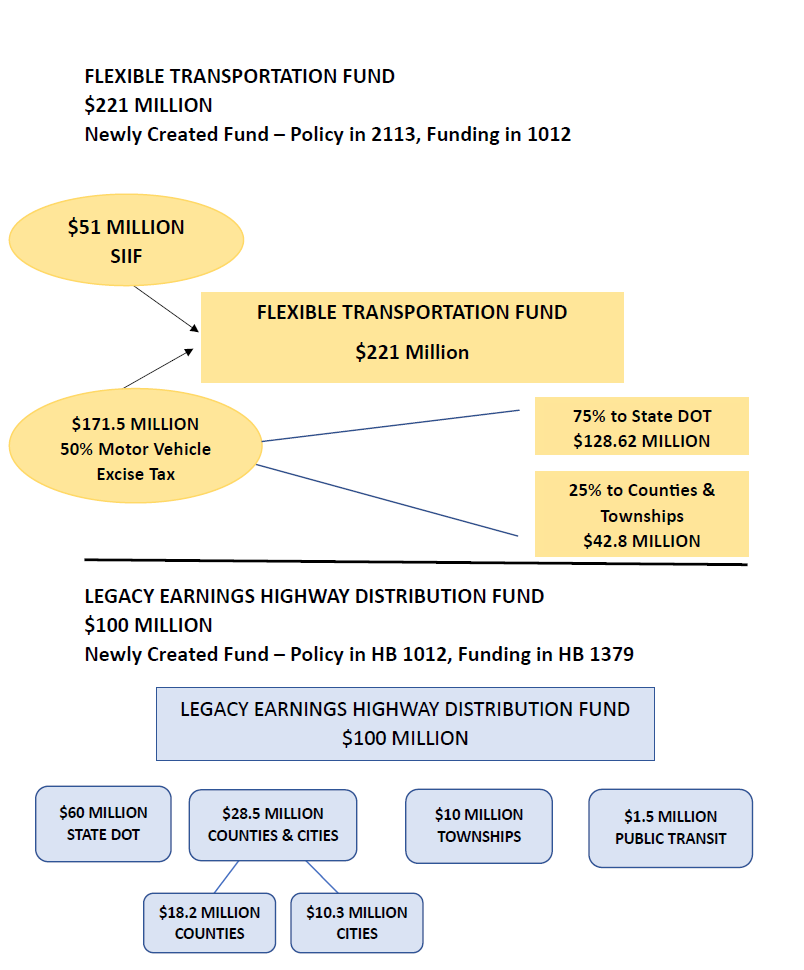
The Legislature made a significant move in adopting a permanent funding formula for road and bridge funding for non-oil counties and townships. There are a few pieces of legislation that work together in accomplishing this: HB 1012 the Department of Transportation budget, HB 1379 the Legacy Fund Earnings or “Streams” bill and SB 2113 which creates a state flexible transportation fund. The illustration is a good way to help understand the infrastructure package (you can click on the image to see it full screen). Together, these bills will provide $81 million to counties, townships and cities and again it will be permanent funding.

Here are the highlights of the infrastructure package:

  • HB 1012 utilizes revenues from the motor vehicle excise tax for road funding. 75% of it will go to the State Department of Transportation and 25% to “non-oil” counties and townships. It is estimated in the next biennium that will be $42.8 million. These funds will be allocated by the DOT director, the director will establish criteria for the funds. The dollars can be used for maintenance and improvements to county and township roads and bridges. Priority is to be given to roads and bridges that serve as corridors and those that need a federal match. These funds will be available August 1st, 2023.
  • SB 2113 establishes a new state flexible transportation fund, which is intended to increase the flexibility and availability of state funding for transportation to support building and repairing a statewide interconnected infrastructure system for all users, on and off the state highway system. The funding is included in HB 1012 which lays out that these funds can be used for matching federal grants. The $221 million will be allocated to the Department of Transportation, however, the funding may support local projects as well.
  • HB 1379 establishes new buckets for appropriating a portion of the Legacy Fund Earnings. 7% of the earnings from the legacy fund goes into the Legacy Fund earnings for this biennium that is expected to be $486 million with $100 million to the newly created Legacy Earnings Highway Distribution Fund. $28.5 of those funds will go to counties ($18.2 million), cities ($10.3 million) and townships ($10 million). It’s important to also note that HB 1379 will distribute $225 million will go into the general fund for legislative tax relief initiatives and $103 million to the Legacy Sinking & Interest Fund. (HB 1379 is scheduled to be voted on in Senate Thursday)

Other bills finalized worth noting include:

  • HB 1225 Online Property Tax Portal – grant dollars available for counties willing to participate
  • HB 1341 Study of Weapons – Required study of restrictions on carrying firearms and dangerous weapons
  • HB 1447 Creates Opioid Settlement Fund – Political subdivisions that have received funds from the litigation may deposit them into the state fund. Representatives from ND Association of Counties & ND State Association of City and County Health Officials to serve on the committee assigned to address spending recommendations. (needs House approval)
  • HB 1508 State Auditor’s Duties – Increases transparency in billing processes and procedures, requires quarterly reports of state Auditor to the legislative audit and fiscal review committee (LAFRC).
  • SB 2248 – Distribution of Drugs Leading to Death – Class A Felony for causing death or injury by distributing illegal drugs. The bill also includes a requirement to report deaths associated with fentanyl and a fentanyl awareness campaign.

Legislature Expected to Wrap Up in Next Week

Monday is day 70 for the North Dakota Legislature. By law, they are limited to 80 days. Lawmakers stayed to work Saturday in conference committees to gain some momentum. Talk in the hallways is that leaders are striving to wrap up bills late this week or next. This week will be all about conference committees that are meeting to work out differences in versions passed between the House and Senate and floor sessions.

There are still many bills of county interest that continue to be worked on including:

HB 1012 – ND DOT Budget – Includes County Road Funding

HB 1379 – Legacy Fund Earnings – Funding Stream for County Roads

HB 1015 – OMB Bill – Guardianship Funding

HB 1158 – Property Tax Relief Package

SB 2012 – Department of Health & Human Services Budget – Includes Zone Equity

SB 2107 – Attorney General’s Enhanced Penalties

Looking back on the week, both the House and Senate put in the hours in floor session, holding multiple floor sessions a day and working into the evening. Of key importance, the Senate acted on and approved HB 1040, the NDPERS retirement bill that proposes to close the defined benefit program to NEW EMPLOYEES and have them join a defined contribution plan. The Senate did amend HB 1040, but we anticipate that the House will concur with those changes and it will be voted on for final approval. SB 2239, which proposes to keep NDPERS open as a defined benefit plan is slated to be voted on in the house and has a Do Not Pass Recommendation. This could happen as early as Monday morning.

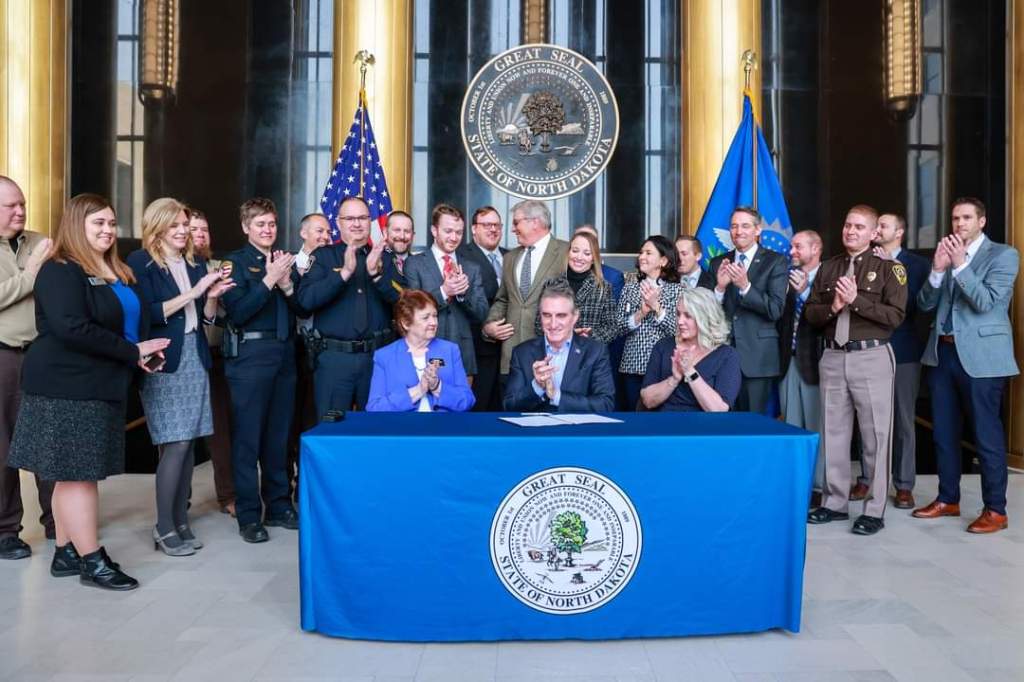
The Governor signed HB 1307 “Back the Blue” legislation. This bill will provide $3.5 million to local law enforcement agencies for recruitment and retention bonuses. $750,000 of the $3.5 million is dedicated to agencies employing ten or fewer employees. The grant dollars will be distributed to cities and counties based on the number of licensed peace officers and correctional officers in their agency. During the news conference Governor Burgum said, “Our local law enforcement agencies work hard to keep our streets and neighborhoods safe, and they do that with our full support. House Bill 1307 demonstrates that ‘Back the Blue’ isn’t just a slogan in North Dakota. It’s actually the respect that we have and a way of life for North Dakotans.” Burgum also signed SB 2147 which exempts law enforcement retirement pay from income tax.

Committees Wrap Up Work on Bills

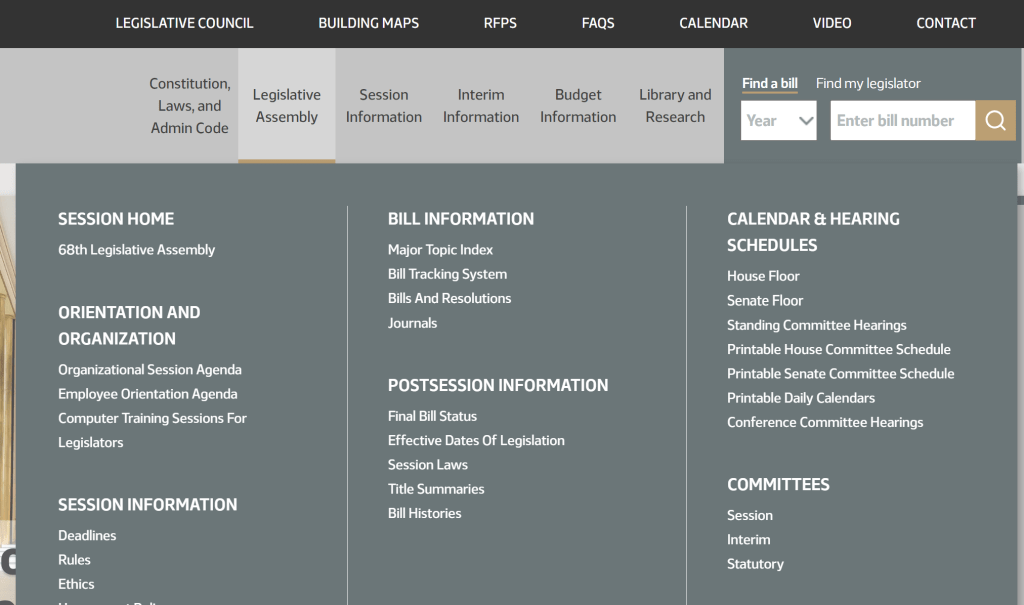
Committees this week worked to finish their work on bills they have heard this session. Almost all policy bills have been kicked out of the committees and Appropriations committees plan to have the budget bills they have been working on ready to be voted on early next week. Next week lawmakers will be focusing their time in conference committees, where three members from each the house and senate will meet and reach compromises on different versions of bills. It’s a very fluid schedule at this point where conference committees are scheduled with very little notice. Conference committee schedules are listed on legis.nd.gov under the session information tab.

There was movement this week on the two bills related to the PERS retirement. Senate Appropriations amended HB 1040 and gave it a 9-6 DO PASS recommendation. HB 1040 proposes to end the defined benefit PERS retirement for NEW EMPLOYEES for both State and Political Subdivisions and move to a defined contribution plan. We expect HB 1040 to be voted on in the Senate early next week. SB 2239, which proposes to keep the Defined Benefit plan open received a DO NOT PASS recommendation from the House GVA committee. This bill will also more than likely be voted on in the House next week. There are pros and cons on both sides of this issue namely whether employees should be provided DB plans or DC plans. For those vested in PERS this change should not affect you as there is a legal obligation to maintain benefits that were promised. There is however a potential long term fiscal impact to counties that is really unknown at this time. (in fairness there is potentially a fiscal impact whether the plan closes or not based on the plans unfunded liability).

Senate Appropriations also passed out two infrastructure funding bills. HB 1012 is the DOT Budget and HB 1379 lays out financial priorities for legacy fund earnings. These bills are changed quite a bit from how they were introduced in the House, so we expect the conversations to continue and they move to conference committee. The graphic helps explain the two proposals. Combined these proposals would allow for counties to share in $60 million for roads and bridges. A link to the graphic is embedded in the graphic.

Friday, during committee work on the Department of Health and Human Service budget (SB 2012), House Appropriators heard a proposal to move all human service zone employees to the state. This proposal was brought forward as an alternative to the equity proposal brought forward by human service zones. The committee rejected the amendment, they also did not include equity funding for human service zone employees.

House and Senate conferees had discussions all week on a tax relief package. HB 1158 was introduced as an income tax relief package. The Senate amended it to include property tax relief (20 mill buy-down for schools) and expansion to the homestead tax credit. The House and Senate are divided on the best mechanism to distribute tax relief and have the greatest impact. The Senate supports property tax relief, the House supports income tax relief.

Lawmakers Completing Committee Work, Starting Conference Committees

The Legislature is now in what is descripted as the 3rd period. All hearings are wrapped up and only a few bills remain in committee. Legislators started holding the first conference committees on bills. Conference committees occur on bills when the House and Senate versions are different and chamber of origin does not approve of the changes made. Three members from each chamber are appointed to serve on the conference committee, where lawmakers work on their differences and negotiate on a version to move forward. Conference committees are scheduled with very short notice and can be held numerous times a day.

As reported on this blog and by statewide media, in the midst of this last (most recent) blizzard, the Governor signed SB2183, providing $20 million in snow removal grants for local government.  Because this had an emergency clause, it goes into effect immediately. The goal is for the funds to be distributed by the end of June. The snow removal reimbursements for qualifying applicants will cover up to 60 percent of their early season snow removal costs and/or season wide snow removal costs that exceed 150 percent of average for each applicant, based on their 4 lowest years of snow removal expenses between 2017 and 2021. NDDES has a webinar scheduled for Monday (10th) to provide further information about eligible costs and the application process.

Regarding longer term road funding action and inaction on bills included:  

  • HB1012, the DOT budget, was worked on and passed out of Senate Appropriations and includes funding for county and township roads. Two funding mechanisms for road funding are proposed in this version including dedicating 25% of motor vehicle excise tax to non-oil county and township road and bridge projects and creating a Legacy Earnings Highway Distribution Fund where a percentage of the earnings from the legacy fund would be allocated to cities and counties using the highway distribution fund formula. Both of these proposals would provide for a more reliable funding stream for county roads.   
  • SB2367 was passed by the House to increase the State General Fund, and Human Services “buckets” ahead of the Prairie Dog bucket for the allocation of oil tax revenues, however the increase of the SIIF bucket was removed.  The SIIF bucket is still ahead of the local infrastructure allocation, but it was not increased as it was in the Senate version – and will therefore undoubtedly go to conference.
  • HB1379, the “Streams Bill”, which includes several allocations for local infrastructure,  is scheduled for Senate committee work next Monday.
  • HB1020, the UGPTI (and NDSU Extension) budget was passed by Senate in a bit different form from the House version, and will likely require additional work.

The Senate debated the future of the NDPERS pension plan for well over and hour before narrowly (29-18) approving HB1040 to close the plan to new employees. The issue now goes to Senate Appropriations for more work. It is scheduled for 4 p.m. Tuesday afternoon.  As additional amendments are expected in that Committee, it will again need a final Senate vote, and quite possibly a conference committee. 

The Senate with a vote of 42-5 approved HB1307 which provides $3.5 million to local law enforcement and local corrections officers for recruitment and retention bonuses. Of the $3.5 million, $750,000 is to be allocated specifically to agencies employing ten or less officers. This will provide those smaller agencies with greater benefit per officer. The funds will be distributed based on the number of licensed peace officers in Sheriffs offices and Police departments and the number of correctional officers in the local facilities. It will be the Sheriff and Chief’s discretion on how to use the funds for hiring or retention bonuses. On average, HB 1307 could provide approximately $1,500 to each local law enforcement and local corrections officer. It appears the House will accept the Senate changes to HB1307 which could happen this next week.

SB2147, which provides retirement income to be tax exempt for law enforcement, was given it’s final approval and is off to the Governor.

The House Judiciary committee made changes to a crime penalty bill, SB 2107, which introduced by the Attorney General to provide mandatory minimum sentences for gun-related crimes and offenses to officers. The House approved the bill but not before Representative Pat Heinert strongly encouraged lawmakers to return the bill to mirror more of it’s original intent in conference committee.

The somewhat unusual HB1119 to mandate local officials only talk about property taxes in dollars (never mills) was defeated by the Senate, garnering only 1 vote. However, similar language was added to at least two other bills, including HB1245 which requires ending fund balance reporting and an interim study of property tax transparency.  HB1245 is headed to the Governor. 

HB1211, expanding the homestead credit program was killed by the Senate, but they had included that in HB1158 before sending it back to the House as an omnibus tax relief proposal.  HB1158 is now in conference committee and seems likely to be the ultimate vehicle for a tax relief package.

And the intoxicated bicycle and horse riding bill (HB1506) is headed to the Governor’s desk.

The best way to stay on top of the fluid schedule at this stage is to monitor the activity via the legislative website. www.legis.nd.gov Go to the session information tab where you can see conference committee hearings and standing committee hearings.

Governor Signs Bill Providing $20 Million to Locals for Snow Removal Assistance

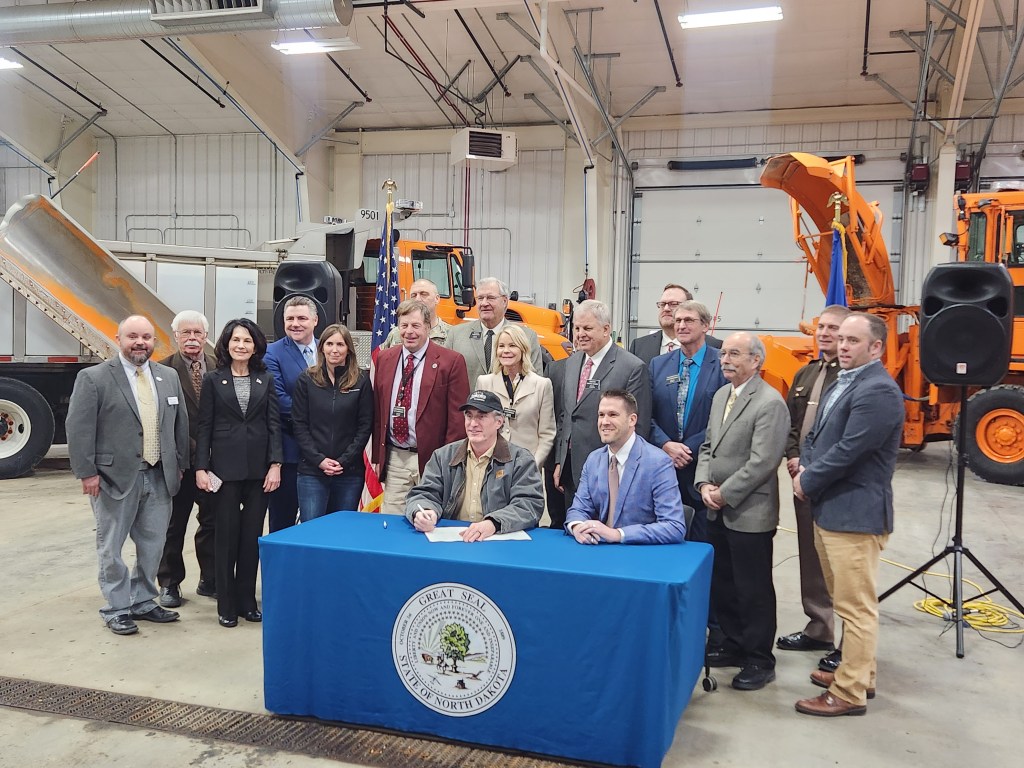
Governor Burgum signed SB 2183 Tuesday morning which provides emergency grants to help cover extraordinary snow removal costs local governments have experienced this winter.

Governor Burgum said, “by expediting $20 million in emergency snow removal grants to qualifying city, county, township and tribal governments, we can relieve some of the burden on communities and local taxpayers and help ensure that while this winter was one for the record books, it doesn’t have to haunt their financial books.”

SB 2183 provides $15 million in funding for reimbursement grants for snow removal costs from October 1, 2022 – December 31, 2022 and an additional $5 million for reimbursement for the period of October 1, 2022 through April 30, 2023. The legislation will allow for reimbursement up to 60% of costs exceeding 150% of the average of four of the last five years’ snow removal costs.

ND Department of Emergency Services will be providing information to each county’s emergency manager by the end of the week with information on how to apply for the grants. DES has also scheduled a webinar for Emergency Managers for Monday to provide an overview of the Snow Removal Assistance Program. All funds will be disbursed by June 30th.

Video of the news conference which also discussed this weeks winter storm and flood preparations can be found on the Governor’s Facebook page.   

Weekly Update

Hearing Schedule for April 3-7th

There are few bills remaining to be heard in the policy committees.  The focus is now on the Appropriations committees and those policy issues that require House-Senate conference committees.  Unfortunately, as the conference committee schedule is updated hourly throughout the week, as conferees become available, it isn’t possible to include in our report which ones will be meeting when, however, that information is posted to the Legislative website as soon as it is decided. 

Regarding NDPERS, you will recall that the Sen. State & Local Gov.  Committee voted last week for a Do Not Pass recommendation on HB1040 (DB plan closure) – well, it was returned to that committee, reconsidered, amendments proposed and rejected, and then neither a Do Pass or Do Not Pass could garner 4 (of 6) votes, so it is now on the Senate floor Without Committee Consideration – rumor is that it will be debated Monday.  Meanwhile, SB2239 (keep the DB plan open) remains in the House Gov. & Vets Committee as the chairman said they wouldn’t discuss that one until next Thursday, once the Senate has taken a crack at HB1040.  A chess game in process. 

After an hour and 9 minutes of debate, the House passed SB2362 (53-38) – primary seatbelt enforcement.  Although this has passed the Senate in the last several sessions, it has never before passed the House.  While an attempt to reconsider is possible (tomorrow only), that seems somewhat unlikely.  The Governor has indicated in the past that he will sign this bill.

The Senate approved HB 1245, which requires political subs to communicate in dollars instead of mills when referencing budgets and taxes. It also requires counties to report ending fund balances to the State Auditor each year, and requires an interim study of property tax transparency. This bill started out as being proposed as a major revamp to the property tax statement but following input from county auditors, the bill was amended heavily. The bill passed the Senate unanimously. HB1119 which also included language to communicate in terms of dollars vs mills and has a Do Not Pass recommendation because the language is in HB 1245.

The bill to provide local funding for snow removal, SB2183, was passed a second time in the Senate in the form of the House, so it is now on its way to the Governor. This includes $20 million for snow removal grants to counties, townships, cities and tribal governments. The bill divides the snow emergency grants into two time periods, up to $15 million is available for the early season snow emergency (October – December) and any remaining funds are available for the full season. Political subs can apply for reimbursement of up to 60% of the snow removal costs incurred which exceeded 150% of the average snow removal costs. The average is using data from the four lowest cost years during the years 2017 through 2021. SB 2183 is an emergency measure which means the funds will be available immediately following the Governor’s signature.

SB2251, the bill requiring written permission to survey land that may be involved in eminent domain was defeated in the House on a 46-46 vote, (Needs 48).  An attempt was made to bring the bill back the next day, but again came up short. Interestingly, even SB2313 that was amended to a study of eminent domain compensation was defeated (40-51) in the House.

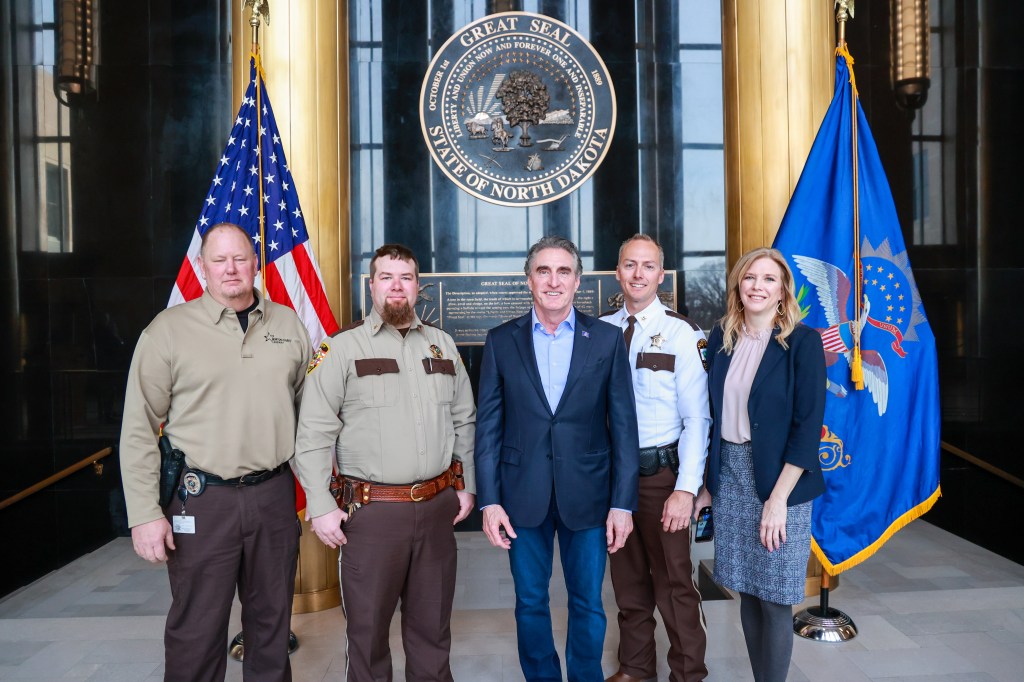
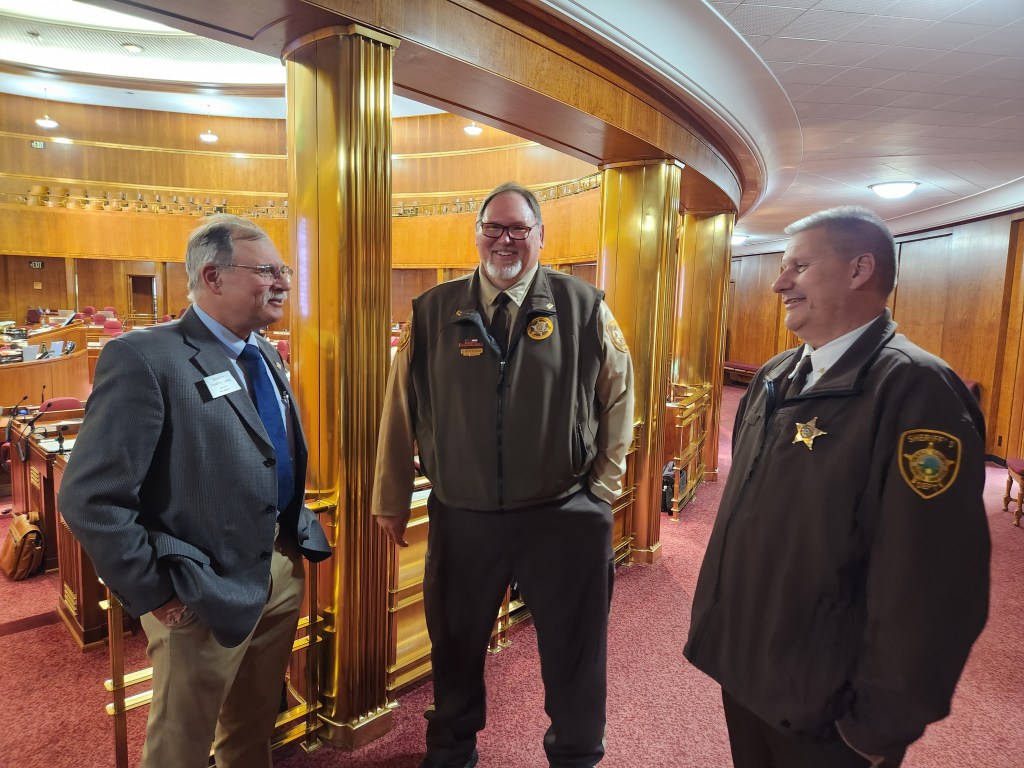
Several Sheriffs came to the capitol to show their support for HB 1307. The Senate Appropriations sub committee heard the bill Monday. The committee passed out the bill with a Do Pass Recommendation but with a reduced appropriation of $3.5 million from the $5 million initially proposed. The bill will provide a grant directly to county and city law enforcement agencies for hiring and retention bonuses. It has been expanded to also include corrections officers.

Last week we reported that SCR4019, a ballot measure to eliminate the 1-mill property tax for the medical school had passed both Houses, well it went back to the House for reconsideration and failed – so that won’t be on the ballot after all.

And in another course reversal – SB2124 addressing state meal reimbursement, had an interesting week.  The bill was soundly defeated by the House (31-59) on Wednesday, but it came back and was passed 59-32 on Thursday.  As the House amended the bill, it raises the daily total from $35 to $45.  This is $3 more than the Senate version, so it goes back for their consideration.

Related to local public health, the Senate defeated HB 1358 to add a seat on the Environmental Review Advisory Council. SB 2253, dealing with onsite septic systems, received a do not pass from the House Industry Business and Labor committee.

The Senate passed out their tax relief proposal through HB 1158. This bill as initially introduced was solely an income tax relief package. The Senate Finance and Tax Committee expanded it to include additional property tax relief and expanded the homestead tax credit. The total tax relief package is $560 million. The House continues to hold numerous Senate bills, It is anticipated they may use one of those to use as a vehicle to move their tax policy forward.

Weekly Report & Schedule for Week of March 27

Legislative Hearing Schedule for Week of March 27th

The hearing schedule is getting shorter, but the issues are getting tougher and more significant.  Tax relief, infrastructure, and NDPERS remain the most difficult as the legislature moves quickly towards the final weeks of the session.

Regarding Tax relief: After combining three separate bills into one comprehensive tax relief policy bill, the Senate Finance & Tax Committee forwarded the hog housed version of HB 1158 to appropriations with a 6-0 Do Pass out of committee.  The hog housed version of HB 1158 changes the lowest income tax rate from 1.1% to 0% for individuals, estates, and trusts; expands the homestead property tax program credit by increasing both income and taxable valuation levels and removing the $500,000 asset threshold; and provides property tax relief for locally assessed properties with a buy down of 20 mills of school general fund levy.  The bill carries a $564 million fiscal note, including $288 million for income tax relief, $71 million for an enhanced Homestead Credit program, and $204 million for property tax relief in school mill levy buy down.  This appears to be  the “Senate vision” of a tax relief package. We will be watching to see how the House responds as they also still hold a few tax policy bills in committee.  

On the infrastructure front, the issue of state, county, and township roads remains very much in flux.  Although SB2329 was defeated in the House, the talk of potentially using excise (sales) tax on vehicles for roads seems to be gaining support as a source of additional road funding, but how much of that will funnel down to local roads remains a question, as does the dedication of Legacy fund earnings for infrastructure.  There remains strong support for donging “something” but the ultimate plan has not come into focus.  SB2183, to provide snow removal grants however was passed by the House and was returned to the Senate for concurrence.

The House bill (HB1040) to close the NDPERS pension plan came out of the Senate State and Local Government Committee with a 4-2 Do Not Pass Recommendation, but it is also scheduled for an Appropriations Committee hearing next week, so there is obviously an expectation by some that it may not be defeated on the floor.  The “Senate alternative”, SB 2239, to keep the pension plan open remains in the House Government and Veterans Affairs Committee.

While the issue of the base funding for Zones seems secure, the issue of “compensation equity” for staff  is yet to be resolved.  Bringing 48 employing counties for social services down to 19 “host counties” left us with some pay and benefit variations that the Legislature is hoping to address.  How effective  they will be at doing this is still up in the air.  However, HB1046, redefining reimbursable indirect costs for human service zones was passed by the House in the same form as the Senate, so it goes to the Governor.

Law enforcement influence was able to turn around a Do Not Pass recommendation this week. HB 1307, also known as the “Back the Blue” initiative had an unfavorable recommendation as Senate appropriations members were supportive of similar language for the initiative that was included in the Attorney General budget. HB 1307 ended up passing with a vote of 27-18. It will have a hearing in Appropriations Monday. The Senate did defeat a bill to require only one license plate which law enforcement had opposed.

HB1192, as Secretary of State bill regarding elections was passed by the Senate with only one negative vote and is now on the Governor’s desk.  Another election bill supported by counties, SB2292, to clarify the requirements of “election observers” was signed into law by the Governor on Thursday.

Despite passage of an 80 mph speed limit on interstate highways, the House Transportation Committee again returned a Do Not Pass recommendation (9-5)  on primary seatbelt enforcement (SB2362), contrary to strong support to county and city law enforcement. This is on Friday’s house floor calendar.

The codification of the core functions of local public health was passed in the House and is also on the Governor’s desk as this report was prepared.

The House approved Senate Resolution 4019 to put a measure on the ballot to eliminate the 1-mill property tax for the medical school.  As a Constitutional Measure, this does not need the Governor’s signature and now will go before the voters.

WEEKLY UPDATE AND SCHEDULE FOR MARCH 20-24th

Click to view Schedule for Week of March 20-24th

Lots of attention to property tax issues during this past week while the Appropriations Committee

HB1247, a mandatory study of exempting off-farm grain and potato storage, was passed by the Senate in the same form as the House and will be studied during the interim. However, SB2279 to implement this exemption was just heard in House Agriculture (not Finance &Tax) this Thursday and the sponsor proposed a hog-house amendment that clarifies but also expands the exemption to commercial storage not owned by a farmer but rented to a farmer. City and county officials urged studying rather than implementation.   A broader study of restructuring the taxation of residential and commercial property that was HB1248 was defeated by the Senate.

The requirement for oil counties to levy 10 mills to get GPT revenues will be repealed with the Governor’s signature on SB2162 as all but 7 House members  agreed with the Senate.

Political Subdivisions raised concerns with SB 2367 in House Finance and Tax which increases the state’s share of the oil and gas tax revenues by $170 million. Counties, cities, townships and airports all urged the committee to look at the bucket formula and help bring funding earlier to the Prairie Dog Buckets. The committee didn’t take action on the bill this week but committee members have indicated they are looking at possible amendments. Meanwhile, the same committee heard SB 2329 which sought to give a percentage of the motor vehicle excise tax to townships and counties. The committee gave the bill a Do Not Pass recommendation.

The Senate adopted SCR 4019 on a vote of 29-18 to put a Constitutional change on the ballot that would  eliminate the 1-mill property tax levy for the UND Medical School.  After a fairly spirited debate, the Constitutional amendment to prohibit all property taxes (HCR3024) was voted down quite soundly – 18 to 75 – with about the same support that Measure #2 received on the ballot in 2012.

An auditor-supported measure, SB 2292 was passed by the House. This addresses election observers along with offenses for causing a disturbance at a polling location,

In a bit of surprise, the House, with encouragement from counties and cities, overturned a Do Not Pass recommendation on SB2370 to expand local gov authority for joint purchasing. The bill passed in the House (75-28) in same form as in the Senate, so this one is also now up to the Governor. 

The House adopted amendments to SB2183 creating “snow removal grants.”  The amendments lower the total available from $25M to $20 million, but make the eligibility a bit easier by changing the threshold to 150% of the average snow removal cost for the four lowest of the last five years. This bill was on Thursday’s floor calendar with a Do Pass recommendation, but due to the House’s Memorial Service, it was not reached – maybe Friday. 

Tobacco was the topic in the Senate on Wednesday with mixed results for Public Health.  HB1229 to allow “cigar bars” was narrowly passed (1 vote) in the Senate, so that is now up to the Governor (unless it comes back).  On the other hand, HB1412 to regulate e-cigarettes like other tobacco products was passed 42-12. In other health news, SB2153, to establish in law the core functions of public health – and supported by Local Public Health – was given a Do Pass recommendation. Student loan repayment for public health professionals was added in to SB2344 on the Senate side but was removed in House.

SB2381, requested by the Recorders regarding the deposit of a will, was amended in the House but has not yet been voted on for final passage. Once passed, it will need to go back to the Senate for concurrence.

The House approved SB 2147 which will allow for law enforcement retirement income to be exempt if they have served 20 years. The House also approved a death benefit for the children of correctional officers killed in the line of duty; the children will receive free college education.

And……..If the Governor agrees with 30 Senators and 72 Representatives, the Curling will be the North Dakota State Sport.

Weekly Update and Schedule for Week of March 13th

Click to view schedule for Week 11 – March 13-17

Thank you to all our county officials who joined us for County Day at the Capitol this week! It was great to discuss legislative issues with you all. We know the weather impacted a lot of your plans, but thankfully we had a good group attending and were able to attend the evening legislative social to network with their area lawmaker. We had some wonderful discussions! We heard a great deal of feedback from legislators about the opportunity to hear directly from the “folks back home”.

Both houses of the Legislature got back to a full week of work on the Floor, but still dealt largely with the “easy” bills, as many had overwhelming votes for passage. A goodly number of the stickier and trickier ones had hearings and not the harder work will start.

A few if the bills resolved this week include:

HB1127 to clean up the bidding statutes for county bridges passed the Senate with no changes so it is on to the Governor.

HB1197 passed the Senate like it did the House and now (if the Governor agrees) newspapers may use their E-editions for public notices. 

The Senate agreed with the House on the study of not taxing off-farm grain storage properties in HB1247, however the Senate Finance & Tax Committee is recommending that the Senate defeat a study of taxing property by square foot rather than value.

Retirement plans are a big issue this Session, the two major PERS related bills both had hearings this week. The Senate defeated the retirement plan for police dogs that was HB1388.

The House approved the Senate’s change to the estimated property tax notice adding last year’s specials – SB2121, goes to the Governor

Townships will be able to carry-over $500,000 in their road fund (legally) with the House’s agreement to SB2178.

Both bodies approved in SB2267, to expand the “rural attorney recruitment program” from 4 to 8 subsidies.

A bill to allow law enforcement to announce when a road is closed vs post it closed was passed along with a bill that increases the penalty for thefts during a riot.

NDACo testified on two resolutions for constitutional measures. HCR 3024 would put a measure on the ballot to change the constitution to abolish local property taxes. HCR 4019 would ask voters to remove the 1 mill on property taxes for the UND Medical School and replace the funding with state dollars.

The Primary Seatbelt bill had it’s hearing on the House side along with the proposal to remove the 10 mill requirement to levy for roads in order for a county to receive Gross Production Taxes.

Update and Schedule for Week 10

Click here to view schedule of bills for March 6-10

A very short week was made even shorter by the winter weather.  Wednesday morning hearings were postponed and the Legislature actually didn’t “gavel in” on Wednesday or Thursday, so there is very little to report for this week.  Most of the hearings addressed those bills that crossed over with little or no opposition, so next week will begin hearings on the more contentious policy issues, and detailed funding proposals. As you can see by the schedule, next week will be intense.

Stay tuned and keep in contact with your legislators – AND SEE YOU AT COUNTY DAY AT THE CAPITOL!