Weekly Update & Hearing Schedule for February 6th

CLICK to VIEW HEARING SCHEDULE FOR FEB 6-10

The discussion of “buckets” was a hot topic again this week, and will undoubtedly be hot to the bitter end.  SB2367, sponsored by the majority leaders and the appropriations chairs, was heard Monday by the Senate Finance & Taxation Committee. It was characterized as being in competition to Senator Wanzek’s bucket bill (SB2275) heard last week.  SB2275 simply eliminates the $400 million strategic Infrastructure and improvements fund (SIIF) which currently sits ahead of the Prairie Dog bucket and was strongly supported by counties, cities, townships and airports.  SB2367, by contrast, keeps the current buckets in place and increases the total dollars by $150 million in four of the seven buckets that sit ahead of the prairie dog bucket – clearly a change in direction. SB2367 adds $30 million into the two $200 million state general fund buckets, $30 million to the $200 million tax relief fund bucket, and $60 million to the $400 million SIIF. While a proposed $30 million increase in the tax relief bucket is possibly a plus, since this bucket was created to fund the human service zones, there is no requirement that the funds be used in this manner. The committee voted to recommend a Do Pass and Rereferral of SB2367 to the Appropriations Committee, but retained SB2275 for further consideration as there is certainly interest in the committee for addressing counties and township infrastructure. Clearly a complex discussion that will take the next three months to resolve.

Several property tax bills were heard this week that proposed a freeze or cap on valuations, mills or budgets. SB 2357 provides a refundable income tax credit up to a maximum of $1000 per household.  The credit is calculated using 10% of the property tax on a primary residence. NDACo opposed SB 2361 which freezes the valuation of a primary residence until the claimant no longer owns the property.  Freezing valuations for one class of property shifts the tax burden to the other property classes and conflicts with the constitutional requirement to equalize property taxes across all property classes. SB 2387 rolls property values back to 2019 for primary residences and ag land, and limits their value increases to 2% or the consumer price index, whichever is less, unless the property has been improved or sold.  NDACo expressed opposition to the value caps proposed in this 16 page bill. HB 1461 proposes a 5% cap on dollars levied over the previous budget year unless approved by 65% of the voters.  Voter approval would be authorized for just one year at a time.  NDACo opposed the 5% levy cap which prohibits local government from the ability to decide how to adequately fund the needs in their communities.  Annual elections would be difficult to administer if not impossible given the current budget and property tax calendar constraints.

The hearing on SB 2277, the bill to move clerks of court to state employment, was continued from last week to allow Chief Justice Jon Jenson testify in support.  NDACo Executive Director, Aaron Birst provided opposing testimony, urging an interim study before implementation. The Committee did not take action, but as it includes a $12 million appropriation to make this move, the bill must be addressed and rereferred to Appropriations.

There was a lot of activity on election related legislation in the House this week.  A bill worked on by the previous and current Secretaries of State to clarify voting statutes and supported by county auditors, (HB1192) was passed. Two election related bills county auditors opposed were defeated in the House. They include: HB 1314, prohibiting county use of ballot drop boxes and HB1405, requiring counties to only use printed pollbooks on election day. The House passed HB1431 to require voters without adequate documentation of citizenship to cast a provisional ballot that will be counted if proof can be provided before canvassing.  The Senate passed unanimously an County Auditor requested bill (SB2292) that provides better guidance for the behavior of “election observers.” 
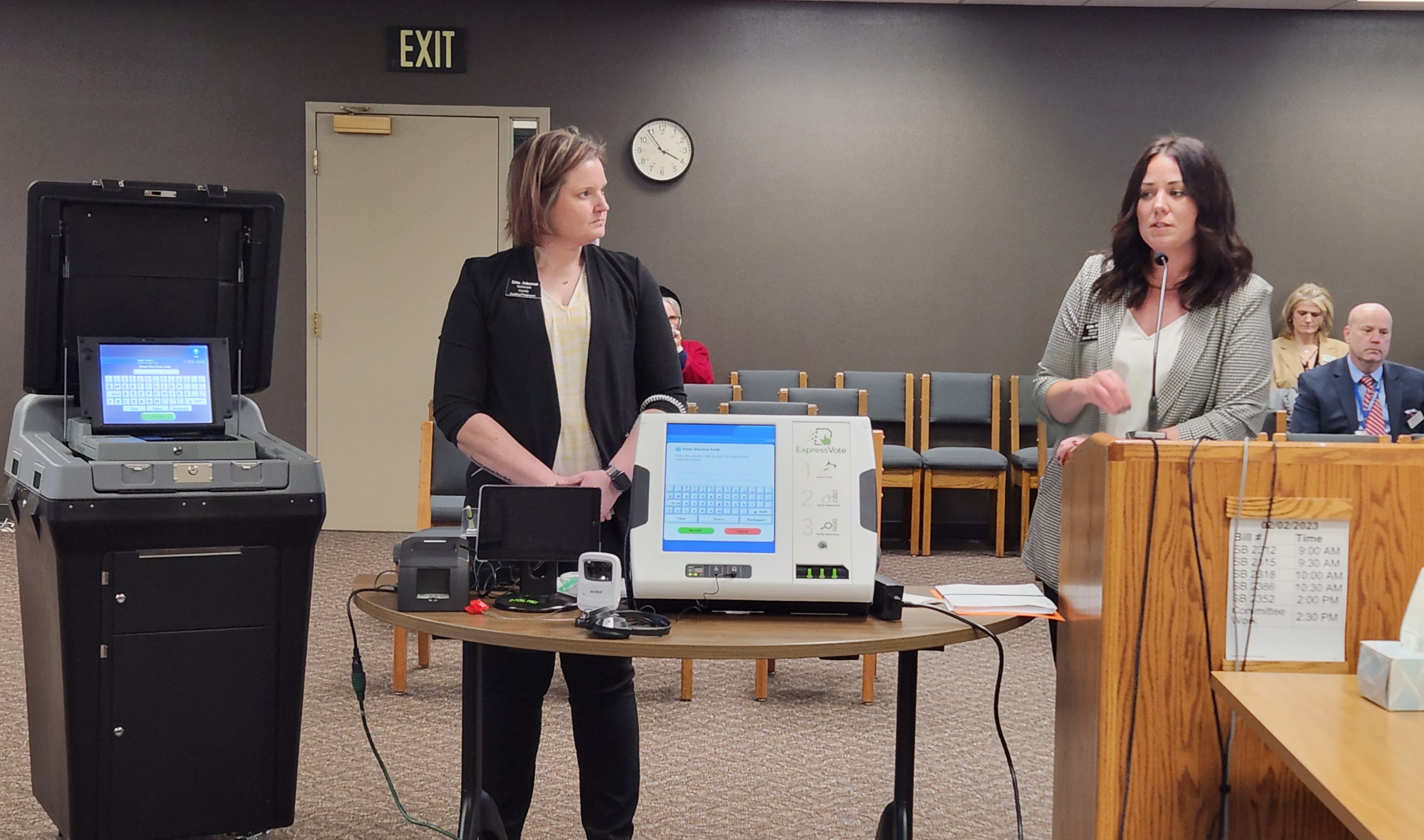
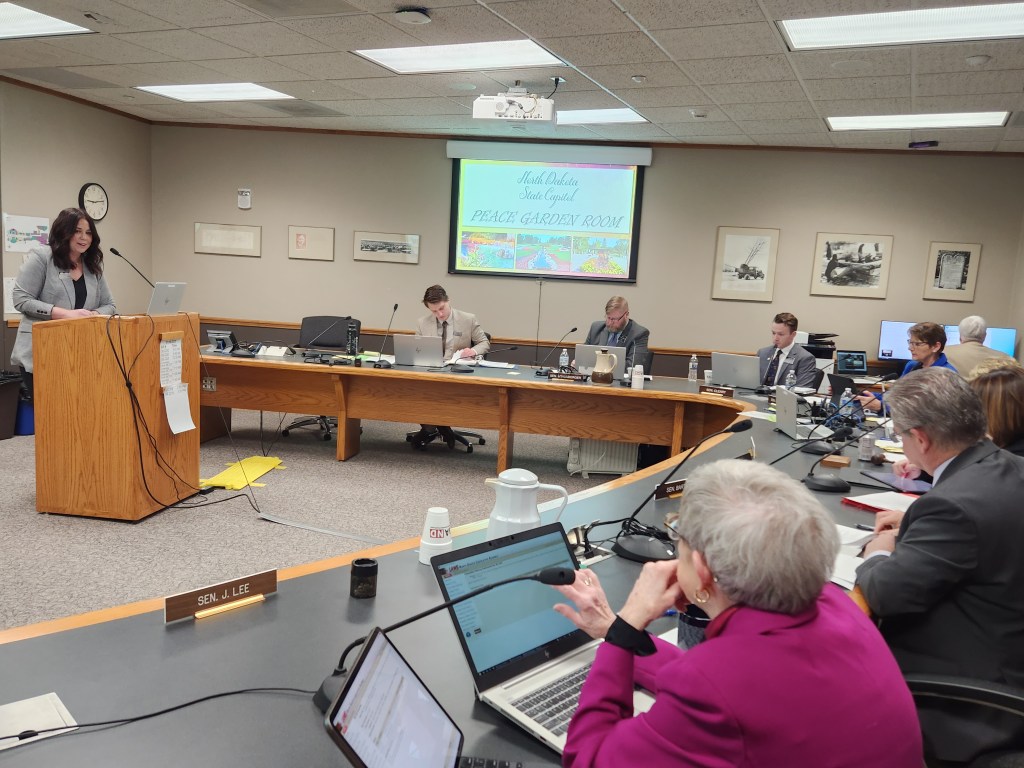
NDACo organized a demonstration of election equipment and an explanation of the election process to lawmakers as there are 35 election related bills being heard this legislative session. McKenzie County Auditor/Treasurer and Burleigh County Election Manager Erika White provided the educational session to the Senate State and Local Government Committee. We brought in election equipment to show the committee and explain the checks and balances in place illustrate the integrity of the election process.

Public safety issues also saw considerable action. The House approved HB 1279 to change the WSI presumptive coverage of law enforcement cardiac events after five years of employment regardless of where that employment occurred. This bill is being fast tracked and had a hearing in the Senate Thursday afternoon as well. The Senate unanimously passed SB2169 to increase the traffic fines for those convicted of those traffic offense three or more times prior. The Senate also approved SB 2168 which increases the fines for excessive speeds. SB 2107, which increases penalties for violent crimes and drug crimes where a firearm is involved. The Senate Judiciary Committee gave the Attorney General’s bill a Do Not Pass recommendation in the Senate Judiciary committee and will be voted on in the Senate next week.
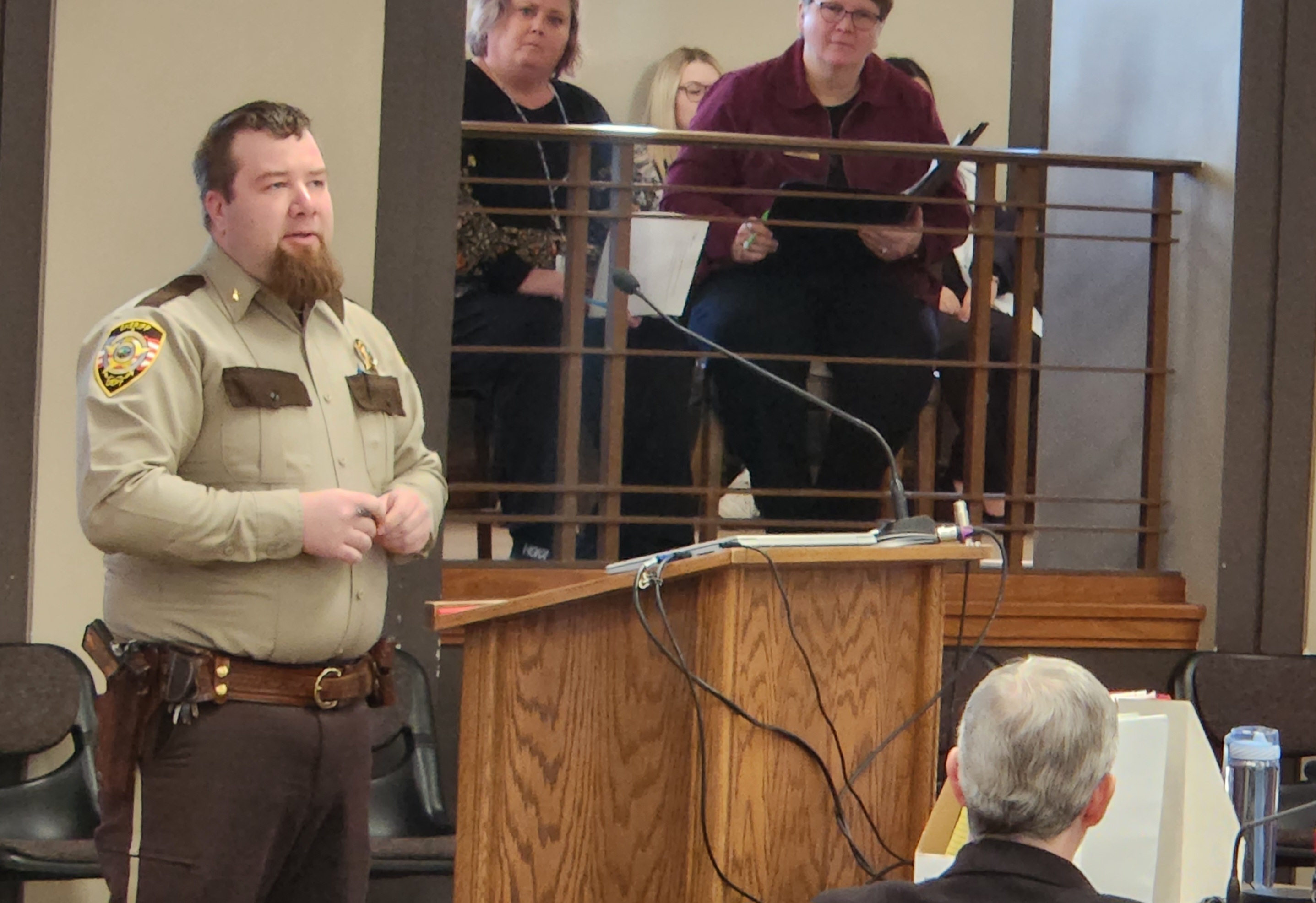
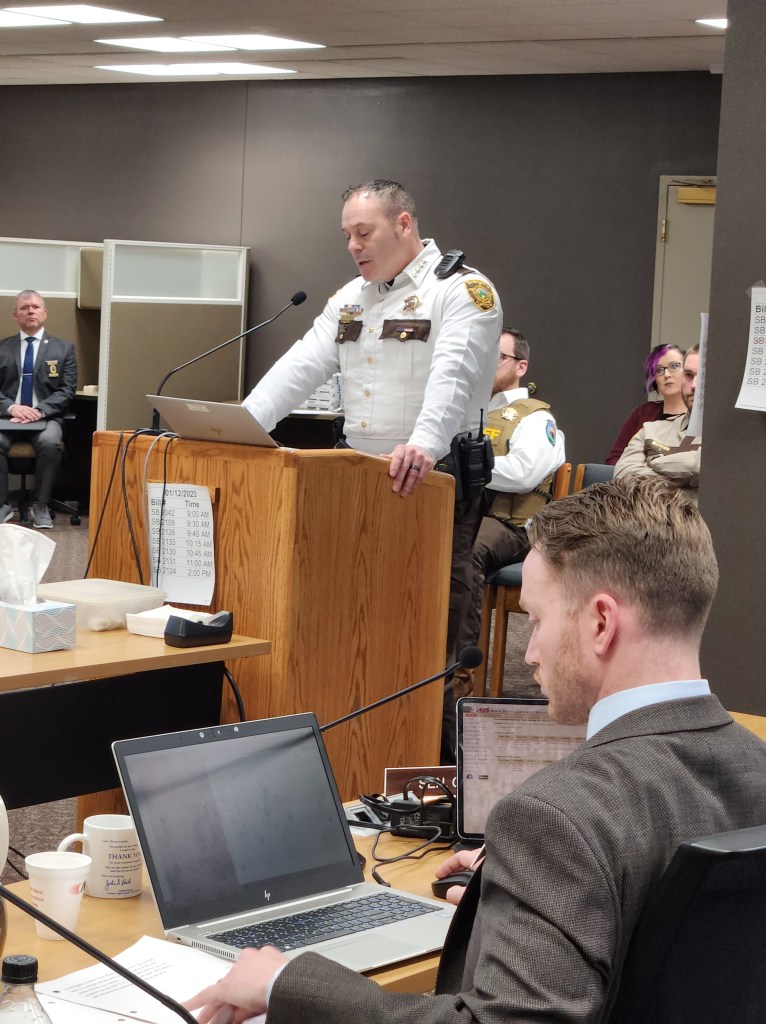
NDACo’s Donnell Preskey and Golden Valley County Sheriff Dey Muckle testified to House Appropriations on the importance of HB 1307 which will provide $5 million to local law enforcement for recruitment and retention. Amendments were presented that would allow for the funding to be directly distributed to Sheriff and Police agencies for them to utilize for hiring or retention bonuses. If approved, this would be one-time funding.

HB1164 which sought to expand the  medical marijuana program to permit edible products was quite soundly defeated in the House 20-72, while drinking when pedaling a pedal-bar was supported by House 85-7.  Allowing the riding of a horse (or pedaling your own bike) while intoxicated (HB1506) was heard this week as well, but no action to report at this time.

All 94 House members supported HB1292 to add recreational projects to the list of eligible activities for the infrastructure loan program.

The Senate addressed the state rates for meal reimbursement while traveling on government business.  SB2124 was introduced at a fixed amount, moving the total from $35/day to $42/day.  The State and Local Government Committee amended the bill to index the rate to 90% of the federal GSA rate for ND (like lodging).  The amendment failed on the Senate floor, so the bill goes to Appropriations in its original form as this will obviously have considerable impact on every agency budget.

On the agriculture front, the return of the beehive setback bill (SB2134) wasn’t considered very sweet, as it garnered only 2 votes on the Senate floor. While the House turned the issue of property tax exemptions for potato/grain storage buildings in cities into a study, the Senate approved (on a very strong 42-5 vote) this exemption in an amended version of SB2279.  The annual application to the county was removed, and the list of “family members” allowed to store farm products was expanded in the amendments.  The “model feedlot zoning” bill, HB1423, received considerable testimony, both for and against.  NDIRFCEO Brennan Quintus spoke against singling out NDIRF coverage in the bill, and there seemed to be a bit of disagreement between the Ag Dept. and the Dept. of Environmental Quality regarding roles.  If this bill is to pass, it appears to need some work.. 

Public health hearings this week heard topics from past legislative sessions including onsite septic systems.  The 2021 Legislature created an Onsite Wastewater Recycling Technical Committee (OWRTC) which met frequently throughout the interim. While the Committee has made good progress, the Committee composition continues to be debated as it was established with gubernatorial appointments of four installers, three local public health representatives and a licensed environmental health practitioner nominated from a professional onsite wastewater recycling association.  SB 2256 seeks to balance the Committee by adding an additional licensed environmental health practitioner from the local public health units and one representative from the Department of Environmental Quality. Local public health units provided testimony supporting this bill.  The subject was also part of SB 2253 introduced earlier in the week which included several changes to the OWRTC responsibilities as established. Replacement of Committee members to five licensees effective August 1, 2024 was among many of the revisions. Senate Industry and Business Chair Doug Larsen requested that installers and local public health representatives meet with Dave Glatt, Director of the Department of Environmental Quality, to discuss the possibility of combining the bills. Further hearings regarding the issue are expected next week.

The House passed HB 1412, which will label electronic nicotine delivery systems as tobacco products in North Dakota statute. The bill would also require retailers selling these products to have a tobacco retailer license, allowing the establishment of compliance check regulations. HB 1357 restricting tobacco products from internet sales failed in the House.

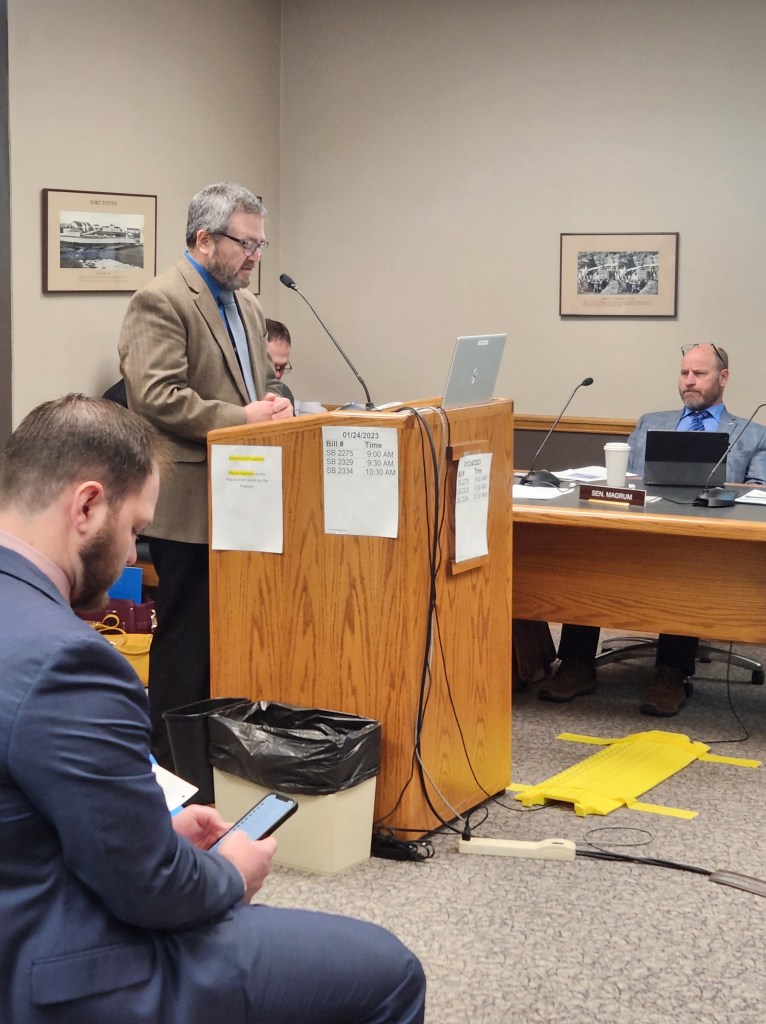
Schedule for Week 5 and Legislative Update

Click here to view the Schedule for January 30th – February 3rd

Finally! The end of “regular” bill introduction was reached on Monday.  Resolutions can still come in for a week, and of course, the Delayed Bills Committee can always authorize a few more; but, by and large, we are now dealing with 538 House bills and 391 Senate Bills – probably not a record, but plenty. Of those 929 bills, 531 of them are of county interest and are included in our tracking lists. With the frenzy of bill writing dying down, the committee and floor activity is picking up.

NDACo along with our partners from cities, townships and airports testified in support of SB 2275 to remove the $400 million Strategic Investment & Improvement Fund (SIIF) bucket that sits in front of the local infrastructure buckets, otherwise known as the Prairie Dog funds. Morton County Engineer John Saiki, emphasized that removal of the SIIF bucket will increase certainty for political subs and aid them in addressing the mounting road and bridge needs. Interestingly, another bill was filed this week that also addresses the buckets but counters our proposal. SB 2367, which is sponsored by the two majority leaders and appropriations chairs, increases the amount of oil and gas tax revenue that would go into the state general fund, tax relief fund an the SIIF buckets. This bill could delay allocations going to cities, counties, townships and airports. No hearing has been set yet for SB 2367.

HB 1486 which would close the PERS defined benefit retirement plan for new employees was heard in the house government and veterans affair committee on Thursday morning. Although a number of similar bills are floating around this session this bill specifically requires political subdivisions to “pony up” for a bigger portion of the unfunded liability. Specifically this bill would requires counties collectively to pay approximately $90 million over the next two bienniums. NDACo is opposed to this specific approach. HB 1040 is the other main PERS bill which was heard earlier this session. That proposes to close the DB plan for new employees and move them to a DC plan. That plan would require a 1% employer increase from the political subs. On Friday, SB2239 will be heard at 9:45 by Senate State and Local Government.  This bill keeps the pension program as it is, with new employees having the option of the defined benefit (pension) OR a defined contribution plan.  This bill requires the state and local government participants to buy down the liability over the next 20.5 years. The fiscal note estimates this requirement increases the employer contribution by 4.6% of salaries. The other main PERS bill that was heard earlier is HB 1040

The subdivisions of the two Appropriations Committees began taking public testimony on the big agency budgets.  McKenzie-Mountrail Zone Director, Desiree Sorenson, addressed the Senate Approps, Human Resources Division, speaking to the Zone support in SB2012 (DHHS Budget). Good questions were asked, and education of the committee will continue.

The policy (Transportation) Committee in the House increased the separate general fund appropriation requested by NDDOT from $35 million to $70 million before passing the bill (HB1103) on to the Appropriations Committee.  This money is specifically for matching federal funding that may be secured in the coming biennium.

NDACo also supported an emergency bill being fast-tracked to provide relief for exorbitant snow removal costs to counties, cities, townships and the state. ND DES is working with counties to collect snow removal costs. The committee discussed changing the threshold from 200% of the 5 year average to 150%. SB 2183 includes $35 million for snow removal.

The bill to eliminate liability for local government to transfer ownership of bridges on closed section lines (HB1206) was defeated on the House floor 6-85.  Also seeing defeat in the House was HB1208 to allow farm “guest workers” to drive semi’s without CDLs.

NDACo’s Linda Svihovec testified in opposition to HB 1367, which sets the preliminary budget deadline for July 10 and provides for citizen referral of the budget by petition.  The committee voted a DO NOT PASS 11-1-2 and the House supported that recommendation for DNP 76-16.

The House Finance & Tax Committee passed HB 1408 which provides an exemption for a portion of the true and full valuation of land enrolled in the state’s PLOTS program.  The original bill called for a 50% exemption and the amended version passed with a 10% exemption 9-3-2.  NDACo supported the merits of the PLOTS program but opposed using local property taxes to incentivize a state program. 

The tax value freeze for all  seniors (without a funding source) was defeated on the House floor 25-67.  This was HB1380.  However there is another, similar bill, yet to be addressed that would have the state pay the property taxes for all seniors.

HB1267, supported by counties, to restore excess receipts from foreclosure sales to the county general fund was narrowly passed in the House (52-41).

An increase to maximum township official annual  salary from $2,000 to $4,000 (HB1236) found favor in the House on a 88-4 vote.

HB1247 as introduced would have exempted potato warehouses and elevators located in cities from property tax if used exclusively for the owner-farmer.  The bill was amended into a required interim study and passed by the House.  A study (HB1248) of moving away from property taxation based solely on square footage (rather than value) was also passed in the House.

It appears this will be another heavy session for election related bills to be discussed. There were several bills with proposals that would change the current election process in North Dakota. County Auditors opposed the following bills on Thursday: SB 2226 to include the full text of constitutional measurers on ballots. HB 1314, which seeks to restrict the use of secure ballot drop boxes. Currently, all counties utilize ballot drop boxes as an option for voters to return their completed ballots. HB 1405, would require pollbooks to be disconnected, making it impossible to identify if an individual votes more than once in addition, the bill would limit counties use of vote centers. SB 2308, would eliminate vote by mail ballots. SB 2316 would result in the manual counting of ballots at the close of polls.

A number of bills seek to address citizenship in relation to voting. Auditors are supportive of HB 1431 which has been worked on by the Secretary of State’s Office and Rep. Scott Louser.

SB 2292 was initiated by county auditors and will provide protections for election officials and poll workers who may encounter individuals looking to disrupt election processes. The bill also addresses election observers and voter privacy.

A complicated bill, SB 2144, sought to require school bond elections to include future operation and maintenance costs on the ballot itself was voted down by the Senate 4-42.

Before unanimous House passage, HB1302 was amended to require the Ag Commissioner to give county commissioners 45 days for zoning review of an anhydrous ammonia facility siting by that office.

HB1361 was given a favorable committee recommendation from House Human Services.  This bill makes it clear that a person charged with murdering their spouse cannot control the disposition of the deceased.

SB2133 to remove funds donated to rural fire departments from audit consideration was an attempt to address the audit exceptions that several departments had this past year.  The State Auditor opposed, but offered options within current law that would possibly be workable.  The Bill was killed in the Senate 9-38.

Jason Benson, Cass Co. Engineer,  gave opposition testimony on SB 2251, which requires permission from landowners to survey and opposition to SB 2313, 33% increase for eminent domain litigation.  Both bills would cause major delays in county road/bridge projects and increase project/admin costs due to the time constraints and potential litigation on eminent domain issues.   

Several firearm related bills were heard this week as well. ND Sheriffs & Deputies Association opposed HB 1483 which would allow guns in public buildings. We emphasized that this would allow for guns in county buildings including law enforcement centers, jails, social service offices, state’s attorneys offices, etc. if they are not included in the courthouse.

Last Friday, while we were all on our phone calls, SB2153, to codify the core function of public health units was passed in the Senate 34-12.

The Senate, with considerable debate, approved doubling speeding fines for those found driving 21 MPH over the posted limit. This bill, SB2168, passed 34-13.

Week 3 Report & Schedule for Week of January 23rd

View the schedule of bills for the week of January 23rd here: Week 4 NDACo Schedule

County Engineers Nick West and Dana Larsen testified in support of HB 1147 which proposes $100 million to local bridges in townships and counties. The engineers helped explain the bridge needs in counties along with the funding challenges related to replacing the many bridges in need of replacement across North Dakota counties. Upper Great Plains Transportation Institute Needs Study indicates there is a total of $715 million in bridge needs over 20 years. This breaks out to $688 million in bridge replacement and $27 million in bridge maintenance.

“I’m excited by the potential impact this bill could have, if passed it certainly would be historic,” said Grand Forks Engineer Nick West. “Counties across North Dakota need long term funding solutions to better plan and prioritize future road projects. Increases in state funding through this bill are critical to maintaining our highway and bridge network. Without this additional funding, we will not be able to keep up with the required maintenance and replacement of our bridges and our system will deteriorate. Consistent
long‐term funding would allow all County’s to effectively plan and construct projects.”

The bill would take interest from the Legacy Fund and divide it into two pots for bridges, $80 million would be distributed to counties, with more than $500,000 in bridge needs based on the UGPTI needs study, a second bucket of $20 million will be available for counties with less than $500,000 in bridge needs. The House Appropriations Committee didn’t take action on the bill.

Also in House Appropriations, NDACo’s Donnell Preskey testified in support of HB 1184, which would provide $18 million a biennium in Law Enforcement Appreciation Grants. She provided the committee with data from a survey conducted with local law enforcement to collect information on recruitment and retention in local departments. “While this bill includes a hefty price tag for you to consider, we as a state, can not afford to do nothing. This is a public safety issue,” said Preskey. “We appreciate your consideration in order to help keep our citizens and communities safe.”

The full Senate Appropriations Committee this week heard the “zone portion” of the DHS Budget – SB2021.  A brief history of social service redesign was given, the process of creating the zones was explained, and importantly, the commitment to unique local services was stated.  The collaborative work among zones and statewide was a point of interest.  The transfer to the DHHS funding account of  98 DHHS employees currently funded in the zone funding stream (property tax relief bucket) was an important factor for the appropriators. The tie to state employee salary adjustments for zone employees was also discussed. More detailed work will be done on this budget by the committee’s Human Resources Division.

Indigent burials were addressed by the Senate Human Services Committee in SB2139.  Testimony of support for this funeral director requested bill was presented by zones and counties, but strong recommendations were made to make it more workable for the zones.  NDACo was asked to chair a working committee of zones, DHS and the funeral directors to bring back suggested amendments.

HB1127 granting counties the authority to replace flooded bridges without bidding passed the House 91-0. The bill also increases the bid threshold to $200,000 for bridges and highways.

A bill to provide an income tax exemption on retired law enforcement benefits (SB2147) passed unanimously in the Senate.

The state requirement that counties levy 10 mills in order to be eligible for GPT revenues would be repealed by passage of SB2162.  The Senate passed the bill on a 46-0 vote.

County Auditors testified in opposition to HB 1245 that would make dramatic changes to tax statements to include a pie chart that indicates the percentage of taxation for each taxing entity. While Auditors agree with the intent of the bill, to increase transparency and understanding of property taxes, their opposition is based on the technical impacts this would have on counties in formatting and software changes that would be required in order for a county to make the changes to the tax statement.

Local public health unit administrator Theresa Will, City-County Health District, testified in support of SB 2153 which formalizes minimum core requirements for the units. The Senate passed the bill this week as well.

Fargo Rep. Jim Kasper introduced his own version of the NDPERS pension closure bill that differs from the interim bill in that the local share of unfunded liability would be paid by political subdivisions – it is HB1486.

Week 2 Update & Upcoming Schedule

Click here to view NDACo tracking of bills to be heard January 16-20

Update from Week 2:

SB2044 that would have moved the transportation funding reports required of counties, cities and townships from the Tax Dept. to the NDDOT was defeated on the Senate floor.  There was some discussion of eliminating the requirement, but the NDDOT said they needed the data, but didn’t have the staff to collect it.

Rep. Heinert’ s bill (HB1119) to require all communication of property taxes to be in dollars instead of mills was passed unanimously in the House.

After vigorous debate, a bill to give a 15-year property tax exemption to natural gas pipelines serving currently unserved communities was passed in the House 92-2.

The State Librarian’s bill (SB2050) to establish greater uniformity in determining local funding efforts for libraries was passed in the Senate  and reported over to the House.

The Senate unanimously passed SB2113 as requested by NDDOT.  This bill creates a separate fund which would permit the State to fund local road projects connected to a state improvement – something currently prohibited for moneys in the state highway fund.

The bill to add “last year’s specials” onto the estimated property tax notice (SB2121) passed the Senate unanimously.

The House Human Services Committee heard testimony on HB1046 to provide updates to direct and indirect Zone costs and outlined a process for making Zone changes. The bill was developed collaboratively with Zone Director’s although several amendments for better clarity were offered by NDACo. No action was taken as the committee will redraft the amendments for consideration.

Sen. Judy Lee introduced SB2136 to increase the maximum taxable value for the homestead property tax credit program. This state-funded assistance for low-income elderly and disabled folks is an important element in efforts to keep people in their own homes as long as possible. NDACo supported the bill but also suggested a possible amendment to index both the income and value limits so that each year they would automatically adjust without bringing legislation every two years. The committee’s seemed interested in the indexing idea, but took no action.

About 20 ND Sheriffs & Deputies attended Law Day at the Capitol Thursday. They met with legislators and sat with their Representatives and Senators during floor sessions. Many attended a hearing to support changes to the ND State Crime Lab.

ND Assoc of County Engineers representative Jason Benson, Cass Co. and Ward County Engineer Dana Larson testified in support of HB 1127 to the House Political Subdivision Committee.  This bill aligns the bidding requirements of the highway and bridge sections of the Century Code.  This bill also increases the bid threshold to $200,000 for bridges and highways.  The committee voted 14-0 as a do pass for the bill.

Friday morning starting at 8:30, the House Government & Veterans Affairs Committee will hear 1039 and 1040, the bills to close the NDPERS Defined Benefit Plan and move new employees to a Defined Contribution Plan. This would impact new hires and apply to the main plan. You can watch the hearing here: https://video.ndlegis.gov/en/PowerBrowser/PowerBrowserV2/20230112/-1/28396

Hearing Schedule for Week 2

Click here to view Legislative hearing schedule for Jan 9-13

It is important to note the bill to close the NDPERS defined benefit and move to a defined contribution plan will be heard Friday starting at 8:30. There are two bills that are identical with exception to the closing date. HB 1039 would make the change 1/1/24 and HB 1040 on 1/1/25. To watch the hearing live or recorded, visit this page on the legislative council website: https://video.ndlegis.gov/

Lawmakers Begin 68th Legislative Session

*Important Note: Legislative Council is experiencing some delays in scheduling next week’s hearing schedule. It is our plan to update the blog when the schedule is complete.

Update for Week 1:

The 68th Legislative Session kicked off this week. There is a new energy in the House and Senate Chambers with 41 new lawmakers and big change ups in leadership positions. Your NDACo Legislative Team has spent most of the week introducing themselves to new members, getting to know their interests and asking how “counties” can help.

Governor Doug Burgum provided a welcome to lawmakers and providing his “State of the State” address. He highlighted North Dakota’s strong economic situation emphasizing the opportunities the state has to grow and diversify along with addressing the state’s workforce challenges.

The Governor asked lawmakers to support $20 million in emergency snow removal grants to be awarded to state, local and tribal governments who have already exceeded their average snow removal budgets, and urged lawmakers to expedite the funding.

Burgum also highlighted as a way to support local law enforcement, $5 million to be used to drive recruitment and retention at the local level.

Infrastructure funding will continue to be a priority this session as the Governor is proposing an unprecedented $2.4 billion investment in infrastructure projects across the state.

He also challenged the legislature to break down restrictions that currently exist in agriculture and allow for growth in the industry, he termed this proposal as “Freedom to Farm”.

Committees spent most of the week getting oriented with new members and organized. However, there were a few hearings of county interest including a bill to add $500,000 into the guardianship program. This is in addition to the funding proposed in the OMB budget. The committee recognized that there is a great need to inject millions into the guardianship system to really address the needs with the state’s most vulnerable citizens.

The North Dakota Legislative Council launched a revamped website www.legis.nd.gov and we urge you to get familiar with it. There are many resources on this site and is the landing site to find lawmaker contact information and bill details.

We also hope you have already signed up for the new NDACo Legislative Blog at ndcounties.blog. NDACo will post weekly hearing schedules at this site along with legislative updates throughout the Legislative Session. Sign up for email alerts when the site is updated at the bottom of the page.

*Important Note: Legislative Council is experiencing some delays in scheduling next week’s hearing schedule. It is our plan to update the blog when the schedule is complete.

New Legislators Sworn In, Committees Assigned

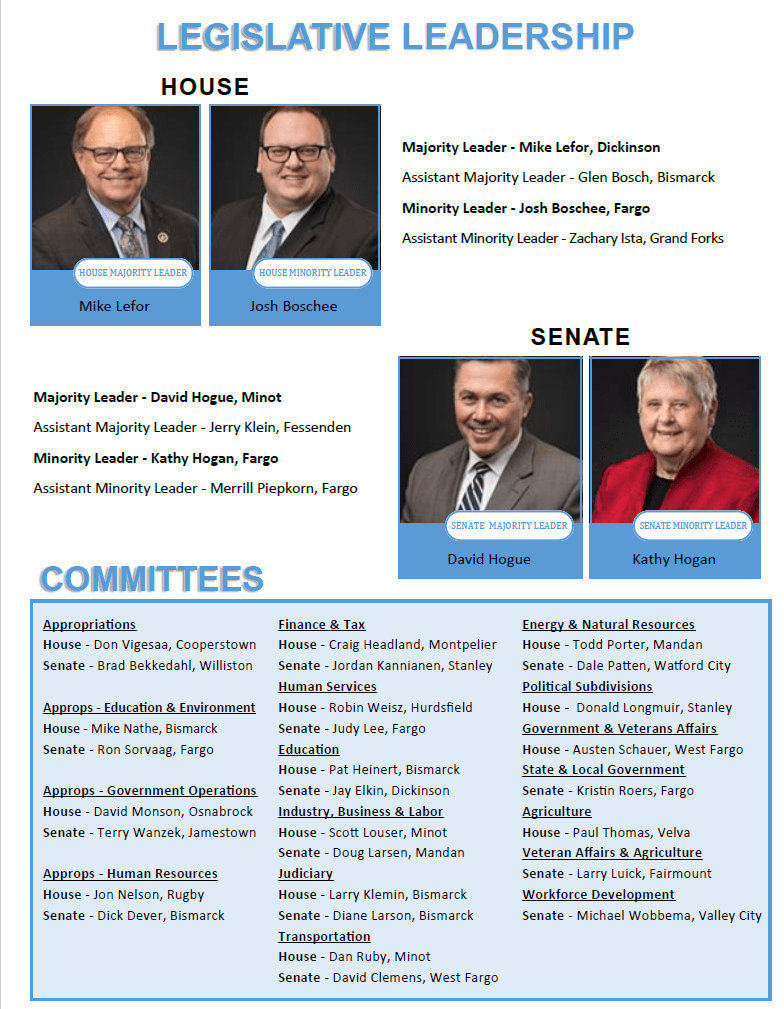
Forty-one new lawmakers were sworn in this week during the ND Legislature’s Organizational Session. This means nearly one-third of the legislators are new to the process and new to county issues. In addition, the House and Senate recently elected new Republican and Democrat leaders. Three out of the four Majority and Minority leaders are new to the role.

During the Organizational Session, legislators heard Governor Burgum’s Budget Address, where he highlighted his priorities for the upcoming session. Lawmakers also picked their desk in their respective chamber and received their committee assignments. Some highlights are:

  • New Appropriations chairs in both House and Senate
    • Senate added three appropriations sub committees
    • New chairmen in 13 committees
    • Senate added a Workforce Development Committee
    • Senate combined part of Government Veterans Affairs and Agriculture to create a Veterans Affairs & Ag committee (House will continue to have both GVA and Ag Committees)
    • Senate revamped Political Subs committee by combining part of GVA to create State and Local Government Committee (House will continue to have Political Subs)

This really highlights how important it is for county folks to meet with their lawmakers in the upcoming weeks to help educate on county government and the issues counties face.

Make sure to tune into the NDACo ILG training Monday, December 12th on the Legislative Process to learn more! Register at ndaco.org

Welcome to our new blog!